

In the fragmented world of Layer 2 rollups, where Arbitrum, Optimism, and Base each host thriving DeFi ecosystems, traders face persistent hurdles in executing seamless Arbitrum Optimism swaps and cross-L2 intents trading. Shared sequencers emerge as a game-changer, enabling intent-based swaps that bypass silos and deliver atomic execution across chains. At RollupSettle. com, our intents-based solution leverages this technology to unify liquidity, cutting latency and costs for everyone from solo traders to liquidity providers. With Arbitrum's ARB token trading at $0.1353, down 0.2820% over the last 24 hours from a high of $0.1368 and low of $0.1245, the timing feels ripe for innovations that boost efficiency in these ecosystems.
Rollups like these optimistic powerhouses rely on sequencers to orchestrate transactions off Ethereum's main chain, batching them for settlement while preserving security. Yet, as adoption surges, the limitations of isolated sequencers become stark: missed arbitrage opportunities, fragmented liquidity, and vulnerability to censorship. Shared sequencers address this by providing a unified ordering layer, allowing a single infrastructure to handle transactions destined for multiple rollups simultaneously.
Decoding the Sequencer: The Heartbeat of Rollup Operations
At its core, a sequencer in L2 rollups acts as the conductor of a high-stakes orchestra. It collects user transactions, orders them fairly, executes the state transitions, and compresses the results into batches posted to Ethereum. In protocols like Optimism or Arbitrum, this entity ensures transactions land in the correct sequence, preventing double-spends and maintaining consensus. Without it, rollups devolve into chaos.
Consider Arbitrum's Nitro upgrade, which brought full EVM parity and bolstered sequencer efficiency, pioneering optimistic rollups. Base, built on the OP Stack, mirrors this with its focus on developer-friendly scaling, while Optimism pushes public goods funding through its sequencer revenue. These chains dominate TVL rankings, but their individual sequencers create islands. A shared sequencer flips this script: one network aggregates intents from across rollups, orders them holistically, and dispatches to respective chains. This isn't just technical plumbing; it's a liquidity multiplier.
The sequencer is the operational core of most rollups, ordering transactions, executing them, and anchoring batches back to L1.
Optimistic Rollups Under the Microscope: Arbitrum, Optimism, and Base
Arbitrum leads the pack, its decentralized proposers enhancing censorship resistance while state roots anchor trustlessly to Ethereum. Optimism's modular OP Stack powers Base, Coinbase's entry that rivals in economics and adoption. Together, they process billions in swaps daily, from Uniswap pools on Arbitrum to perpetuals on Optimism via GMX.
Yet, empirical analysis of swap data reveals arbitrage gaps due to asynchronous settlement. Traders eyeing Base rollup DEX action can't easily pivot to Arbitrum liquidity without bridging delays. Enter intents: user-specified outcomes like "swap USDC for ETH at best rate across chains. " RollupSettle. com excels here, using shared sequencers to fulfill these without users micromanaging paths.
Centralized sequencers, run by rollup teams, rake in fees but invite risks. Arbitrum and Optimism, as of recent audits, centralized this function, profiting handsomely yet exposing users to potential downtime or frontrunning. MEV extraction stays siloed; a builder can't efficiently sandwich a Uniswap trade on Arbitrum alongside GMX on Optimism.
Centralization Pitfalls and the Shared Sequencer Revolution
Mechanisms like Arbitrum's Timeboost aimed to curb latency wars and internalize MEV, but studies show they spurred spam and recentralized power. Centralized models dominate revenue for zkSync, Base, and peers, per Rollup 2.0 analyses. Shared sequencers decentralize this: networks like Movement's M1 use node consortia for ordering, slashing censorship risks.
Flashbots' atomic cross-rollup arbitrage via shared infrastructure exemplifies the upside, coordinating sequencers for risk-free execution. For DeFi traders, this means intents routed optimally, whether hitting shared sequencers intents for multi-chain swaps or settling via RollupSettle. com's low-latency engine. As ARB holds at $0.1353, these advancements signal sustainable scalability in a multi-chain future.
Arbitrum (ARB) Price Prediction 2027-2032
Based on shared sequencers adoption, rollup interoperability, and L2 ecosystem growth trends
| Year | Minimum Price | Average Price | Maximum Price | YoY % Change (Avg from Prev Year) |
|---|---|---|---|---|
| 2027 | $0.18 | $0.30 | $0.55 | +100% |
| 2028 | $0.35 | $0.65 | $1.20 | +117% |
| 2029 | $0.50 | $1.10 | $2.20 | +69% |
| 2030 | $0.80 | $1.80 | $3.50 | +64% |
| 2031 | $1.20 | $2.80 | $5.50 | +56% |
| 2032 | $1.80 | $4.00 | $8.00 | +43% |
Price Prediction Summary
Arbitrum (ARB) is positioned for substantial long-term growth due to shared sequencers enabling seamless intent-based swaps and atomic cross-rollup transactions across Optimism, Base, and other L2s. From a 2026 baseline of ~$0.15, average prices are forecasted to multiply over 25x by 2032 in bullish scenarios, with minimums reflecting bearish market cycles and maximums capturing peak adoption-driven rallies. Risks include sequencer centralization and competition from zk-rollups.
Key Factors Affecting Arbitrum Price
- Adoption of decentralized shared sequencers enhancing interoperability and reducing MEV centralization
- L2 TVL and DeFi volume surge from cross-rollup atomic swaps
- Ethereum scaling synergies and Nitro upgrades boosting Arbitrum usage
- Regulatory developments favoring L2 solutions
- Market cycles with bull runs in 2028 and 2032
- Competition from Optimism, Base, zkSync, and emerging rollups
- Technological advancements like Timeboost improvements and sequencer decentralization
Disclaimer: Cryptocurrency price predictions are speculative and based on current market analysis. Actual prices may vary significantly due to market volatility, regulatory changes, and other factors. Always do your own research before making investment decisions.
By pooling transaction flow, shared sequencers unlock cross-rollup composability natively. Imagine an intent to swap on a Base rollup DEX, arbitrage via Optimism, and settle on Arbitrum, all atomically. This isn't hype; prototypes and research back it. Visit this deep dive on atomic trades for the mechanics. RollupSettle. com stands ready, powering this interoperability with intents fulfillment that prioritizes execution over paths.
Traders leveraging shared sequencers intents gain a decisive edge, as unified ordering minimizes frontrunning and maximizes execution quality. In my two decades analyzing blockchain trends, I've seen scalability bottlenecks stifle growth; shared sequencers dismantle them, fostering a multi-chain ecosystem where liquidity flows freely.
Intent Fulfillment: From User Desire to Atomic Execution
Intents represent a paradigm shift in DeFi interaction. Rather than dictating precise routes, users declare outcomes: "Acquire ETH using USDC at the best rate across Arbitrum, Optimism, or Base. " RollupSettle. com's engine interprets these, dispatching to a shared sequencer network that holistically orders competing demands. This ensures atomicity; transactions either fully succeed or revert entirely, sidestepping partial fills and bridging hazards.
Picture a liquidity provider monitoring Base rollup DEX pools spotting a mispricing against Optimism's GMX. With traditional silos, execution fragments, inviting slippage. Shared sequencers aggregate these signals, enabling solvers to bundle arbitrage in one ordered batch. Empirical swap analyses across these rollups underscore the untapped potential: billions in daily volume, yet arbitrage capture lags due to sequencer isolation.
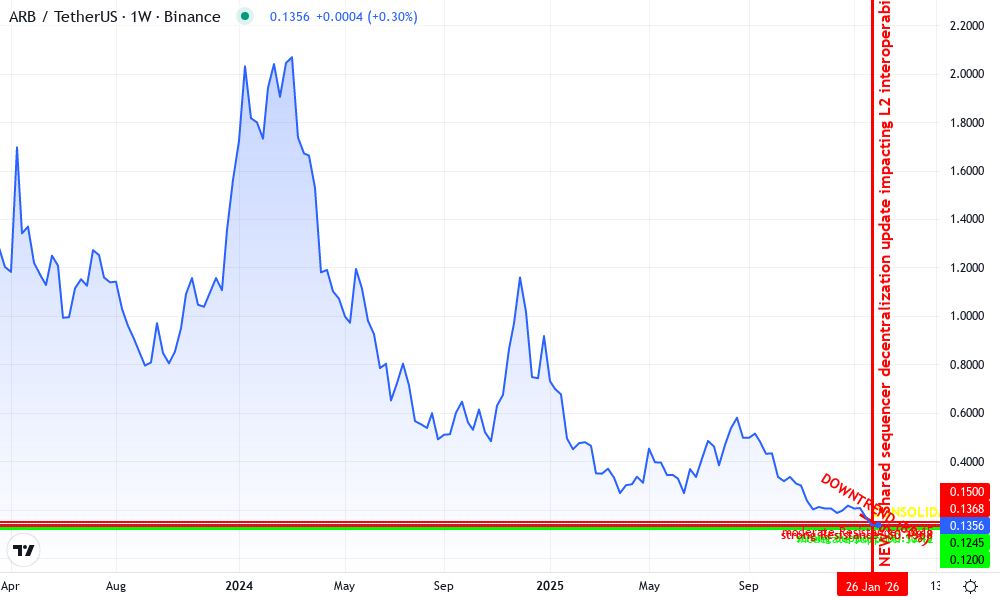
Arbitrum Technical Analysis Chart
Analysis by James Patel | Symbol: BINANCE:ARBUSDT | Interval: 1W | Drawings: 7
Technical Analysis Summary
As James Patel, my conservative technical overlay on this Arbitrum chart emphasizes drawing a primary downtrend line from the recent swing high on 2026-01-15 at $0.180 to the current level near $0.1353 to highlight the ongoing corrective phase amid rollup ecosystem maturation. Add horizontal lines at key support $0.1245 (24h low) and resistance $0.1368 (24h high). Use a rectangle to box the recent consolidation zone between $0.130 and $0.140 from 2026-01-28. Place callouts on declining volume and a downward arrow on MACD bearish signal. Vertical line for recent sequencer news impact. Long position marker near $0.130 entry with stop loss below $0.122.
Risk Assessment: low
Analysis: Technical downtrend is mature with oversold signals; fundamentals in optimistic rollups and sequencer upgrades provide strong margin of safety for long-term holders
James Patel's Recommendation: Accumulate on dips near $0.130 for portfolio allocation, hold through 2026 volatility targeting sustainable scalability gains
Key Support & Resistance Levels
📈 Support Levels:
- $0.125 - 24h low acting as immediate support, aligns with prior session lows strong
- $0.12 - Psychological round number and volume cluster support moderate
📉 Resistance Levels:
- $0.137 - 24h high, immediate overhead resistance strong
- $0.15 - Prior consolidation resistance from late January moderate
Trading Zones (low risk tolerance)
🎯 Entry Zones:
- $0.13 - Near strong support with positive sequencer fundamentals, ideal low-risk accumulation low risk
🚪 Exit Zones:
- $0.16 - Measured move target from recent range expansion 💰 profit target
- $0.122 - Below key support to limit downside 🛡️ stop loss
Technical Indicators Analysis
📊 Volume Analysis:
Pattern: declining
Volume drying up on downside, indicating weakening selling pressure and potential base formation
📈 MACD Analysis:
Signal: bearish
MACD line below signal with histogram contraction, confirming momentum slowdown
Applied TradingView Drawing Utilities
This chart analysis utilizes the following professional drawing tools:
Disclaimer: This technical analysis by James Patel is for educational purposes only and should not be considered as financial advice. Trading involves risk, and you should always do your own research before making investment decisions. Past performance does not guarantee future results. The analysis reflects the author's personal methodology and risk tolerance (low).
For developers building on rollups, this means richer composability. Integrate RollupSettle. com's API, and your dApp taps unified liquidity without custom bridges. Liquidity providers benefit too, as intents route to deepest pools regardless of chain, optimizing yields. As ARB trades steadily at $0.1353, reflecting measured market digestion of L2 upgrades, these tools position participants for the long haul.
Navigating Challenges: Toward Robust Decentralization
Decentralization remains the linchpin. While proposals like decentralized proposers advance censorship resistance, full shared sequencer networks demand rigorous incentives. Node operators must stake against malicious ordering, with slashing for deviations. Movement's M1 illustrates this, its node consortium balancing speed and fairness. Yet, Timeboost-like mechanisms remind us: good intentions can breed spam if economics misalign.
Flashbots' coordinator auctions offer a blueprint, auctioning state locks for atomic cross-rollup plays. This internalizes MEV democratically, distributing revenue beyond rollup teams. In a shared model, builders extract value across Uniswap on Arbitrum and GMX on Optimism seamlessly, but decentralized governance ensures no single actor dominates. RollupSettle. com aligns here, prioritizing solver competition to fulfill intents transparently.
Looking ahead, Rollup 2.0 hinges on sequencer convergence. Optimism's OP Stack, powering Base, lends itself to shared extensions; Arbitrum's Orbit chains could plug in natively. As TVL concentrates in these leaders, interoperability via shared sequencers isn't optional; it's the path to Ethereum-scale liquidity.
From my vantage as a CFA charterholder tracking DeFi's maturation, RollupSettle. com embodies this vision. Its intents-based settlement via shared sequencers cuts through fragmentation, empowering cross-L2 intents trading with precision. With ARB at $0.1353 amid stable conditions, now's the moment for protocols and traders to adopt these efficiencies. Sustainable scalability builds lasting wealth; fragmented chains merely delay it.
| Sequencer Model | Pros | Cons |
|---|---|---|
| Centralized | Fast, revenue for rollups | Censorship risk, siloed MEV |
| Shared/Decentralized | Atomic cross-chain, fair ordering | Coordination complexity |
Embrace the shared sequencer era. Platforms like RollupSettle. com make Arbitrum Optimism swaps effortless, turning multi-chain complexity into competitive advantage.




No comments yet. Be the first to share your thoughts!