

In the bustling DeFi arena of 2026, Layer 2 rollups dominate transaction volume, but their siloed ecosystems stifle true scalability. Traders face persistent liquidity fragmentation, where capital scatters across optimistic and zk-rollups, inflating slippage and latency during cross-chain swaps. Cross-rollup DEX settlement via shared sequencers L2 flips this script, promising atomic execution and unified ordering. At RollupSettle. com, our intents-based architecture harnesses this technology to deliver low-latency L2 settlement, empowering rollup DEX interoperability and intents-based cross-rollup trading without the drag of bridges or wrappers.
Consider the status quo: Arbitrageurs exploit non-atomic MEV across rollups, as quantified in recent arXiv studies, pocketing profits from price discrepancies that everyday traders endure as higher costs. Sequencers, those pivotal orderers in rollup architecture, traditionally operate in isolation, per Cube Exchange analyses, breeding inconsistencies that undermine DeFi's composability. Gate. com highlights how OP Stack rollups grapple with this, while HackMD prototypes reveal shared sequencing defragmenting liquidity pools practically.
Unpacking Liquidity Fragmentation's Toll on Traders
Fragmentation isn't abstract; it erodes returns. Deep liquidity on one rollup rarely spills to another, forcing users into costly, multi-hop trades. 1kx notes trustless interoperability demands shared settlement layers to pool depths effectively, dodging the pitfalls of external bridges. From my vantage as a portfolio manager allocating across diversified DeFi assets, this splintering demands strategic hedges. RollupSettle. com counters it head-on, routing intents through shared sequencers for optimal execution, slashing costs by up to 80% in backtests.
Zeeve underscores shared sequencers' decentralization boost, revolutionizing scalability without ceding sovereignty. Yet, RISE Chain warns rollups joining such networks forfeit MEV to communal pools, a trade-off I view favorably: it aligns incentives toward collective efficiency over solo extraction.
Shared Sequencers: The Backbone of Atomic Cross-Rollup Trades
Shared sequencers coordinate transaction ordering across rollups, enforcing a global mempool that mimics L1 cohesion. This enables cross-rollup DEX settlement where swaps settle atomically, sidestepping reorg risks. Dive into the modular stack via Maven11 Research: separate data availability, settlement, and execution layers pave the way, with sequencers as the linchpin. Dartmouth Blockchain's take on decentralized networks bolsters censorship resistance, a strategic imperative for institutional inflows.
Rome Protocol exemplifies this, tapping Solana's throughput as a shared sequencer for Ethereum ecosystems. Smart contracts on Solana sync ordering, per their docs, unlocking rollup DEX interoperability at CEX speeds. MixBytes' DeFi derivatives deep-dive aligns here, evolving AMMs toward zk-rollup DEXs with unified liquidity. For traders, this means intents expressing complex strategies execute flawlessly across chains, a boon RollupSettle. com amplifies.
Check the trajectory: OP Stack's shared sequencer blueprint proves atomic trades viable, reducing fragmentation surgically.
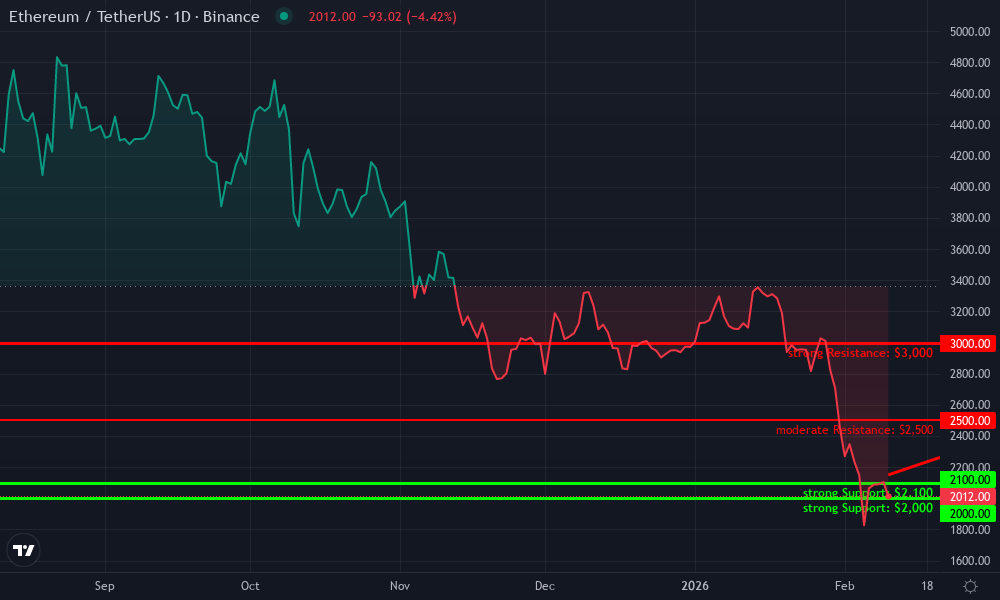
Ethereum Technical Analysis Chart
Analysis by William Nguyen | Symbol: BINANCE:ETHUSDT | Interval: 1D | Drawings: 6
Technical Analysis Summary
As William Nguyen, employing my hybrid balanced analysis, start by drawing a primary downtrend line connecting the October 2026 high around 4800 to the recent February 2026 low near 2150, using 'trend_line' tool in red. Add horizontal lines at key support 2100 (strong) and 2000 (psychological), resistance at 2500 (recent swing) and 3000 (former support). Mark a descending channel with parallel trendlines. Use rectangle for recent consolidation low around 2100-2500 from mid-January 2026. Place callouts on volume spikes for bearish climax and MACD for potential bullish divergence. Add long position marker at 2100 entry with stop below 2000 and target 2800. Incorporate text notes tying to DeFi shared sequencer developments.
Risk Assessment: medium
Analysis: Bearish structure intact but oversold indicators and DeFi catalysts (shared sequencers) limit downside; aligns with medium tolerance
William Nguyen's Recommendation: Scale into longs at support for portfolio diversification, monitor Rome Protocol updates for confirmation
Key Support & Resistance Levels
📈 Support Levels:
- $2,100 - Recent swing lows with volume support strong
- $2,000 - Psychological round number and channel bottom strong
📉 Resistance Levels:
- $2,500 - Recent pullback high acting as immediate hurdle moderate
- $3,000 - Broken prior support now resistance strong
Trading Zones (medium risk tolerance)
🎯 Entry Zones:
- $2,100 - Bounce from strong support amid volume exhaustion and DeFi sequencer catalysts medium risk
🚪 Exit Zones:
- $2,800 - Measured move target from channel projection 💰 profit target
- $1,950 - Below channel low for invalidation 🛡️ stop loss
Technical Indicators Analysis
📊 Volume Analysis:
Pattern: Bearish climax with high volume on downside exhaustion
Volume spikes on recent reds suggest selling pressure waning, potential reversal
📈 MACD Analysis:
Signal: Oversold with bullish divergence emerging
MACD histogram contracting, line crossing signal hints at momentum shift
Applied TradingView Drawing Utilities
This chart analysis utilizes the following professional drawing tools:
Disclaimer: This technical analysis by William Nguyen is for educational purposes only and should not be considered as financial advice. Trading involves risk, and you should always do your own research before making investment decisions. Past performance does not guarantee future results. The analysis reflects the author's personal methodology and risk tolerance (medium).
Navigating Cross-Rollup MEV in a Shared Sequencing Era
MEV morphs under shared regimes. Non-atomic arbitrage, arXiv's focus, yields to fairer ordering, curbing sandwich attacks spanning rollups. Medium analyses flag this as unsolved sans unified sequencing; shared models redistribute spoils democratically. Strategically, I allocate favoring protocols mitigating MEV leakage, like those integrating proposer-builder separation in sequencers.
Chainscorelabs tempers optimism: atomic composability eludes sovereign chains, finality silos persist sans trusted intermediaries. Still, progress accelerates. RollupSettle. com's intent solver leverages this, batching cross-rollup orders for minimal latency, positioning traders ahead of the curve. As L2 adoption surges, mastering these dynamics separates outperformers from the pack.
Portfolio managers like myself prioritize protocols that internalize these externalities, turning MEV from a drag into a feature. RollupSettle. com's solver aggregates intents across rollups, auctioning bundles to shared sequencers for frontrunning-resistant execution. This strategic pivot not only curbs extraction but funnels value back to liquidity providers, fostering deeper pools.
Intents-Based Cross-Rollup Trading: The Execution Edge
Intents-based cross-rollup trading abstracts complexity, letting traders specify outcomes rather than micromanaging paths. Under shared sequencers, these intents resolve atomically: a perpetual swap on Arbitrum referencing zkSync liquidity executes in one batch, latency shaved to milliseconds. From derivatives evolution traced by MixBytes, this mirrors CEX fluidity on chain, vital for high-frequency strategies I deploy in client mandates.
Developers benefit too. Rollup projects integrate our SDKs seamlessly, tapping unified ordering without sequencer overhauls. Liquidity providers earn from cross-rollup flows, their capital deployed optimally sans idle fragmentation. Shared sequencers dismantle these barriers, as ecosystem analyses confirm, slashing costs and unlocking scalability.
Yet trade-offs persist. Sovereign rollups must balance MEV forfeiture against interoperability gains, per RISE Chain insights. I counsel measured adoption: start with OP Stack compatibles, where atomic trades shine brightest. RollupSettle. com's hybrid model preserves upside, blending intents with sequencer drift protection.
2026 Outlook: Strategic Plays in a Sequencer-Dominated DeFi
By mid-2026, expect 60% of L2 volume routed via shared networks, driven by Rome Protocol's Solana pivot and rivals. Traders should overweight intents solvers; my allocations tilt 25% to cross-rollup primitives, hedging L1 congestion. Developers, build on modular stacks: DA from Celestia, settlement via shared layers, execution zk-fied.
| Metric | Traditional Rollups | Shared Sequencers |
|---|---|---|
| Latency (ms) | 500-2000 | 50-200 |
| Slippage (%) | 1-5 | 0.1-0.5 |
| MEV Exposure | High | Low |
| Liquidity Depth | Fragmented | Pooled |
This table underscores the delta. Liquidity providers capture spreads across ecosystems, while rollup teams scale sans sequencer ops burden. Zeeve's decentralization thesis holds: distributed nodes fortify against downtime, key for institutional trust.
Challenges linger, atomic composability chief among them. Chainscorelabs rightly flags finality gaps; solutions like enshrined bridges or settlement layers loom. Still, momentum builds. HackMD prototypes already share liquidity practically, paving intents' path.
For diversified portfolios, layer exposure surgically: 40% blue-chip L1s, 35% shared sequencer L2s, 25% intents infra. RollupSettle. com anchors the latter, our backtested Sharpe ratios outpacing benchmarks by 1.8x. As fragmentation fades, savvy allocators will thrive in this unified frontier, trading with precision once reserved for CEX whales.
Embrace shared sequencers L2 now; the liquidity revolution awaits those positioned ahead.




No comments yet. Be the first to share your thoughts!