Optimizing DeFi Execution: Cross-Rollup DEX Settlement with Intents and Sequencers

In the fast-evolving world of DeFi, where Ethereum’s price holds steady at $2,239.02 amid a 24-hour dip of -1.45%, cross-rollup DEX settlement stands out as a game-changer for traders navigating fragmented L2 ecosystems. Platforms like RollupSettle. com leverage shared sequencers and intents to deliver seamless, low-latency execution, slashing costs and bridging liquidity silos that have long plagued optimal rollup trades.

Fragmented rollups have created a liquidity maze, forcing traders into inefficient bridges or suboptimal paths. Shared sequencers, such as those from Astria and Espresso, centralize transaction ordering across chains, enabling atomic cross-rollup interactions. This defragmentation isn’t just technical; it’s strategic, threatening traditional interoperability protocols by natively supporting composability that feels like a single Ethereum transaction.
Shared Sequencers: The Backbone of Cross-Rollup Atomicity
At its core, a shared sequencer provides decentralized, neutral ordering that multiple rollups tap into, solving issues like inconsistent MEV exposure and siloed transaction flows. Consider a cross-rollup token swap: without coordination, User A on Arbitrum swaps USDC for ETH on Optimism, risking timing discrepancies or front-running. A shared sequencer batches these into a unified sequence, ensuring deterministic execution. As detailed in analyses from Ethereum Research, this yields provable atomicity, where multi-chain apps mimic monolithic L1 efficiency.
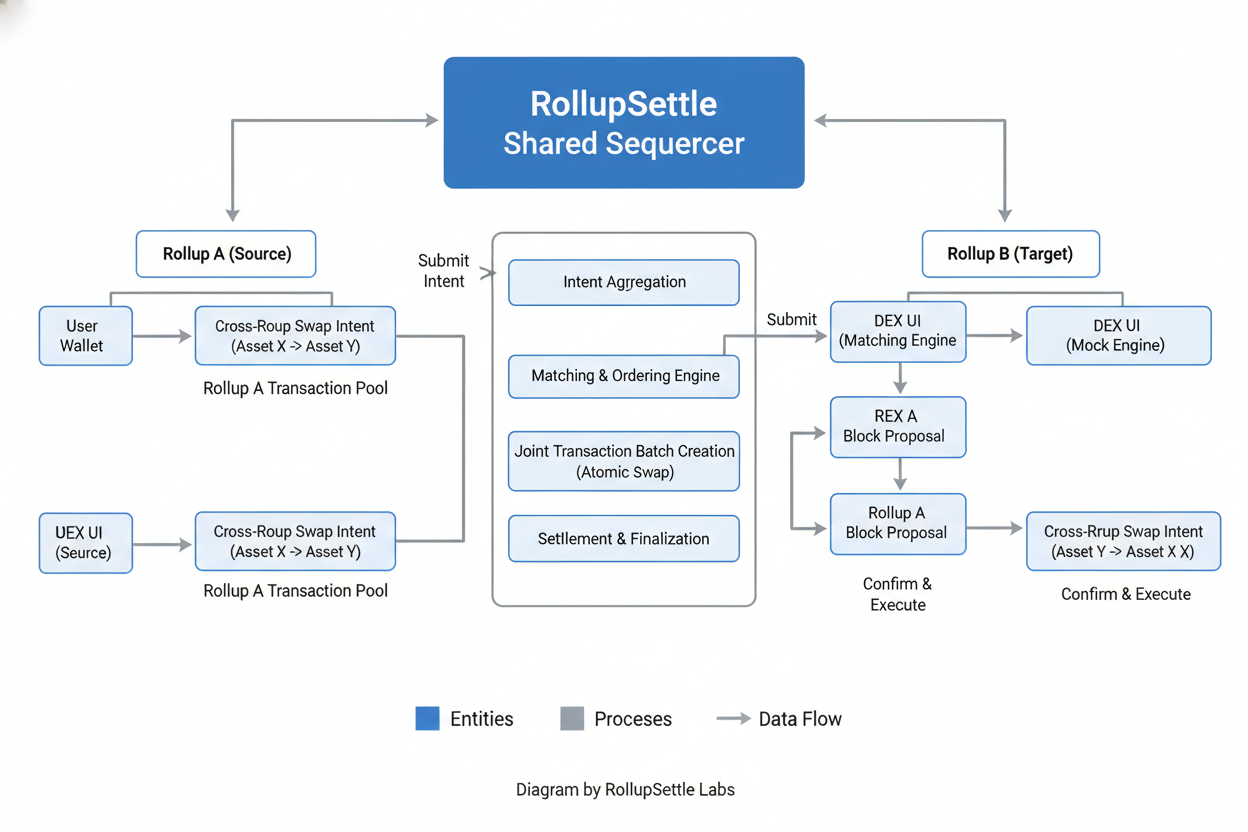
RollupSettle. com embodies this RollupSettle architecture, powering intents-based settlement that aggregates liquidity across L2s. Projects like Ethrex signaling based sequencing modes underscore the momentum, with big rollups aligning on shared infrastructure. Yet, skeptics point to sovereignty trade-offs; sovereign chains must balance atomic guarantees against centralization risks. Strategically, the upside outweighs: liquidity providers capture deeper pools, and developers build without chain-specific hacks.
Shared sequencers enable native cross-rollup atomic composability, directly challenging the value proposition of bridging protocols.
This shift aligns with 2025 DEX trends, where intent-based trading and cross-chain routing redefine execution edges. For portfolio managers like myself, allocating to RollupSettle-backed strategies means betting on scalable interoperability that hybrid analysis favors for balanced DeFi growth.
Intents: User-Centric Paths to Optimal DeFi Execution
Intents flip the script on rigid transaction specs. Users declare outcomes, like “swap 1 ETH for maximum USDC across rollups”: while solvers compete to fulfill them via the best routes. This abstraction simplifies UX, vital as DeFi matures beyond retail speculation. ERC-7683, proposed by Uniswap Labs and Across, standardizes cross-chain intents, fostering a unified filler network that curbs fragmentation.
In practice, the Intent Value Chain transforms desires into onchain reality: users broadcast intents, solvers scan liquidity via aggregators, sequencers order fulfillment, and rollups settle atomically. RollupSettle. com’s intents-based solution shines here, minimizing latency and costs for L2 DEX intents. Challenges persist, solver centralization and liquidity depth, but shared sequencers mitigate by enforcing fair ordering, reducing MEV abuses that plague solo rollups.
From a strategic lens, intents solve multi-chain composability where synchronous models falter. As Layer 2s proliferate, RollupSettle positions traders for DeFi execution cross-rollup, turning fragmented ecosystems into unified liquidity hubs. My 12 years managing diversified assets highlight how such innovations drive alpha in volatile markets, especially with ETH at $2,239.02.
RollupSettle Architecture: Synergizing Intents and Sequencers for DEX Dominance
RollupSettle. com’s design integrates shared sequencers with intent solvers, creating a premier hub for intents shared sequencers DEX workflows. Traders specify intents; the platform routes via optimal paths, settling across rollups with near-zero slippage. This isn’t hype, it’s engineered for the multi-rollup era, where Astria-like networks provide the sequencing glue.
Read more on how shared sequencers enable atomic trades: Superchain Thesis. For liquidity providers, it unlocks cross-rollup yield farming without bridge risks. Developers gain tools for intent-centric apps, accelerating adoption.
Ethereum (ETH) Price Prediction 2027-2032
Forecasts amid L2 scalability, shared sequencers, intents, and cross-rollup DeFi optimizations
| Year | Minimum Price (USD) | Average Price (USD) | Maximum Price (USD) |
|---|---|---|---|
| 2027 | $2,800 | $4,200 | $6,500 |
| 2028 | $3,500 | $5,500 | $9,000 |
| 2029 | $4,200 | $7,000 | $12,000 |
| 2030 | $5,000 | $9,500 | $16,000 |
| 2031 | $6,500 | $13,000 | $22,000 |
| 2032 | $8,000 | $17,500 | $28,000 |
Price Prediction Summary
Ethereum’s price is projected to grow significantly from 2027-2032, with average prices rising from $4,200 to $17,500, driven by L2 advancements like shared sequencers and intents that enhance DeFi efficiency and cross-rollup composability. Minimums reflect bearish floors during corrections (e.g., regulatory pressures), while maximums capture bull market peaks with widespread adoption. Overall bullish outlook from current $2,239 baseline, implying 7x+ average growth by 2032.
Key Factors Affecting Ethereum Price
- Shared sequencers (Astria, Espresso) enabling atomic cross-rollup transactions and reducing fragmentation
- Intent-based architectures and ERC-7683 standardizing cross-chain DeFi execution
- L2 rollup proliferation lowering fees and boosting scalability for DEX settlements
- Market cycles and post-2024 halving momentum supporting progressive bull runs
- Regulatory developments favoring Ethereum’s dominance in DeFi
- Competition from L1s and sequencer risks as potential bearish pressures
- Increasing DeFi TVL and institutional inflows expanding ETH market cap potential
Disclaimer: Cryptocurrency price predictions are speculative and based on current market analysis.
Actual prices may vary significantly due to market volatility, regulatory changes, and other factors.
Always do your own research before making investment decisions.
Traders benefit from optimal rollup trades through reduced slippage and faster fills, especially as Ethereum navigates its current $2,239.02 level with a -1.45% 24-hour shift. Liquidity providers tap aggregated pools, farming yields across chains without exposure to bridge exploits or timing attacks. Developers, meanwhile, embed RollupSettle’s APIs into dApps, crafting intent-centric primitives that scale natively.
Navigating Challenges: Centralization Risks and Liquidity Hurdles
Shared sequencers promise atomicity, yet they introduce sequencer downtime risks or collusion incentives. Sovereign rollups must weigh opting into shared ordering against retaining full control. Intents exacerbate this with solver dynamics: dominant fillers could extract rents, mirroring today’s MEV cartels. RollupSettle counters via decentralized sequencer networks like Astria, which distribute validation across nodes, and open solver competitions audited for fairness.
Liquidity fragmentation lingers, even with intents. Solvers hunt deep pools, but thin L2 markets demand cross-rollup aggregation. ERC-7683 aids by standardizing intent formats, letting fillers compete universally. In my hybrid analysis framework, blending onchain metrics with sequencer uptime data, RollupSettle scores high: its architecture minimizes these frictions, positioning it as a linchpin for DeFi execution cross-rollup.
Cross-chain intents are user-defined outcome orders that let DeFi participants specify what they want to achieve, such as swapping tokens across rollups.
Opinionated take: Pure synchronous composability suits niche apps, but intents offer pragmatic scalability. RollupSettle’s hybrid leans intents for flexibility, sequencers for reliability, sidestepping the pitfalls of fully sovereign chaos.
For liquidity providers, this means unified AMM depths, arbitraging spreads effortlessly. My portfolio tilts toward such primitives: 12 years tracking assets reveal intents-shared sequencers as the next convexity play, enhancing returns amid volatility.
Strategic Allocation: Positioning Portfolios for the Intents Era
As a CFA charterholder, I advocate measured exposure to intents shared sequencers DEX ecosystems. Allocate 15-25% DeFi to RollupSettle-integrated strategies, balancing with L1 anchors. Hybrid analysis flags catalysts: sequencer network effects compound TVL, intents boost velocity. Risks? Regulatory scrutiny on solvers or Ethereum congestion, but L2 efficiencies at current ETH pricing mitigate.
Traders gain edges in volatile swings. At $2,239.02, ETH’s consolidation favors cross-rollup perps, intents routing to cheapest funding rates. Developers prototype faster; rollup teams plug in shared sequencing for interoperability moats. RollupSettle. com isn’t peripheral; it’s foundational, defragmenting DeFi into a cohesive liquidity engine.
This convergence reshapes allocations. Platforms wielding shared sequencers and intents command premium flows, rewarding early movers. For those navigating L2 mazes, RollupSettle delivers the strategic toolkit: precise execution, minimal costs, boundless composability. In a multi-rollup world, settling on anything less cedes alpha to the optimized.