
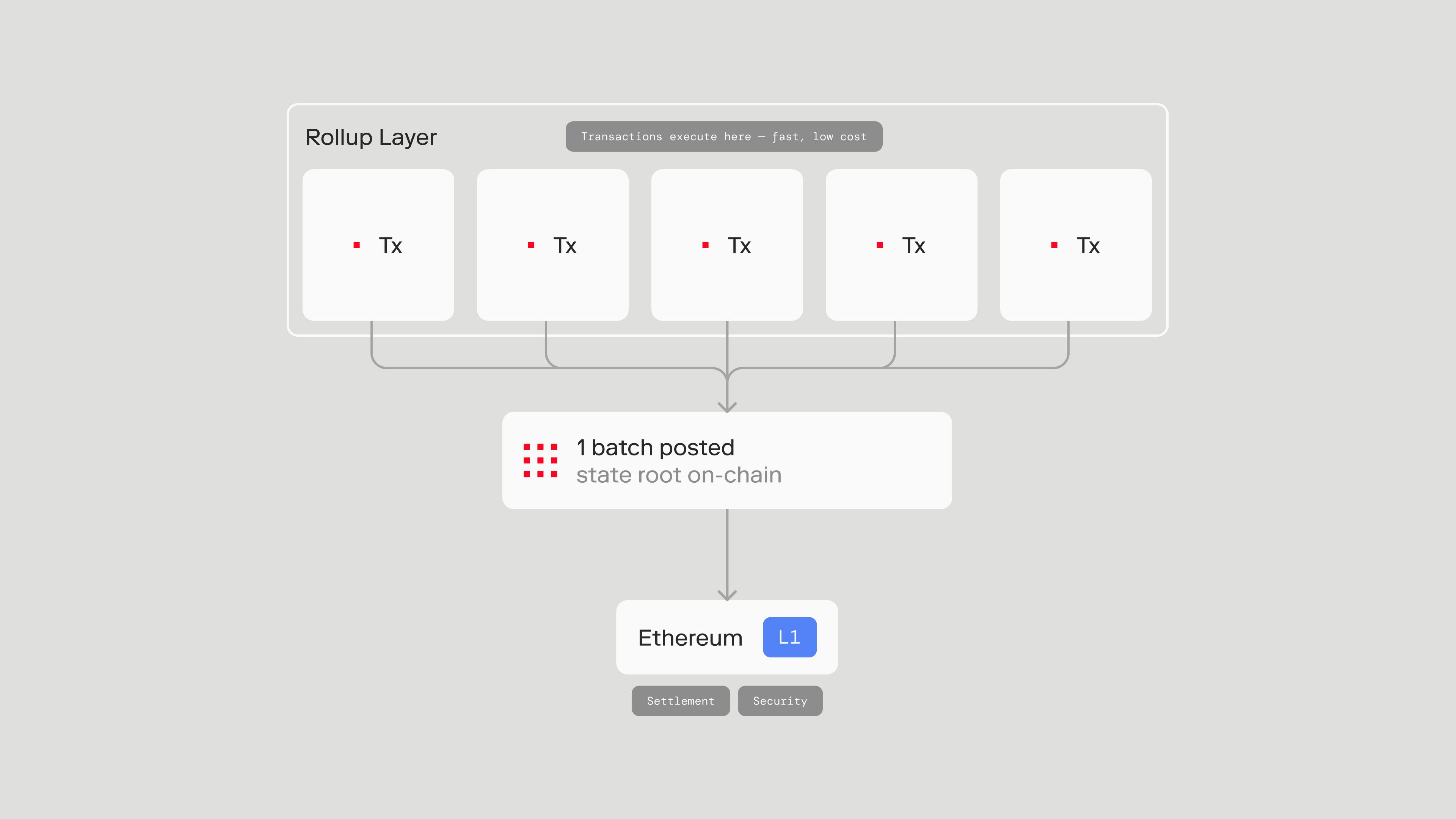
How rollup settle anchors L2 security
Rollup settle is the mechanism that binds Layer 2 state to Layer 1 security. It is the critical link that ensures user funds remain protected by Ethereum's consensus. Without this anchor, a rollup is merely an off-chain database with no cryptographic guarantee of integrity. Settlement transforms a collection of transactions into a verified, immutable record on Ethereum.
The process begins with data availability. Whether using Optimistic or ZK rollups, all transaction data must be posted to Ethereum. This step ensures that anyone can reconstruct the state, preventing sequencers from censoring history or losing data. Data posted to L1 is cheap to store but expensive to verify, making it the foundational security layer.
Verification differs by rollup type but serves the same purpose. Optimistic rollups assume transactions are valid unless challenged during a fraud-proof window. ZK rollups submit cryptographic validity proofs that are verified instantly on-chain. In both cases, the final state root is committed to Ethereum, allowing bridge contracts to settle deposits and withdrawals securely.
This settlement layer creates a trust boundary. Users rely on Ethereum's economic security to resolve disputes or recover funds. As the total value locked in rollups grows, the importance of this finality layer increases. The security of billions in assets depends on the robustness of this single connection to the base layer.
How optimistic rollups settle transactions
Optimistic rollups process transactions off-chain and batch the results onto Ethereum Layer 1, inheriting the same security guarantees as the base settlement layer. This approach assumes every submitted state update is valid by default, relying on a challenge period rather than immediate cryptographic proof to enforce correctness. The sequencer aggregates these transactions and posts the new state root to the bridge contracts, which use the accepted state on Ethereum to finalize deposits and withdrawals.
This "optimistic" model introduces a specific friction point: the withdrawal delay. Because the system must wait for a designated window—typically seven days—during which anyone can dispute a fraudulent state root, users cannot access their funds instantly. This period is not merely administrative; it is the primary security mechanism that allows validators to detect and revert invalid transactions before they are considered final.
The impact on capital efficiency is significant. Liquidity remains locked in the bridge contracts for the duration of the challenge window, creating a drag on user experience and institutional adoption. While this delay ensures robust security by prioritizing correctness over speed, it requires traders and institutions to plan for extended settlement timelines. In high-stakes finance, where capital velocity matters, this latency represents a structural trade-off between the simplicity of optimistic verification and the immediacy of capital access.
ZK rollups and instant finality
Zero-knowledge rollups shift the burden of trust from validators to mathematics. Instead of waiting for a challenge period to expire, ZK systems generate a cryptographic proof that verifies the validity of an entire batch of transactions in a single step. This proof is submitted to the Layer 1 settlement layer, which only checks the signature of the proof generator. If the math holds, the state is updated immediately and irrevocably.
This mechanism eliminates the withdrawal delays inherent to optimistic rollups. In an optimistic network, users must wait seven days to ensure no fraud proofs are submitted before they can move funds. ZK rollups remove this waiting period entirely. The moment the proof is accepted on-chain, funds are final. For DeFi protocols requiring rapid capital turnover, this reduction in latency is not just a convenience; it is a structural advantage that reduces counterparty risk during volatile market conditions.
The tradeoff lies in computational cost. Generating zero-knowledge proofs requires significant processing power, often making the per-transaction cost of proof generation higher than the fraud-proof verification model. However, as hardware accelerators and circuit optimization improve, this gap is narrowing. The result is a settlement layer that prioritizes certainty over cheap computation, offering a robust foundation for high-frequency financial applications.
Settlement costs and gas fee dynamics
The choice between optimistic and zero-knowledge (ZK) rollups directly dictates the baseline cost of on-chain settlement. While users interact with the rollup network, the finality of those transactions depends on data availability and proof verification on Ethereum's L1. EIP-4844 (Proto-Danksharding) introduced a structural shift in this dynamic by creating a cheaper data layer, but it did not eliminate the fundamental cost divergence between the two settlement models.
Optimistic rollups, such as Arbitrum and Optimism, post transaction calldata to L1. Under EIP-4844, this data is stored in blobs, which are significantly cheaper than standard calldata. However, the cost per user still scales with the amount of data posted. Because optimistic rollups rely on fraud proofs that are only challenged after a delay, the settlement latency is high (typically 7 days), but the immediate gas overhead is lower due to the lack of complex cryptographic verification on L1.
ZK rollups, including zkSync and Starknet, post succinct cryptographic proofs instead of raw data. This approach requires minimal on-chain computation to verify the proof, resulting in faster finality (often within minutes). However, the cost structure is different. ZK rollups must cover the computational expense of generating proofs off-chain and the cost of posting the proof data on L1. While EIP-4844 reduces the data cost for both, ZK rollups often benefit more from the efficiency of proof aggregation, potentially offering lower per-transaction costs at high throughput scales.
The table below compares the key settlement metrics for optimistic versus ZK rollups in the post-EIP-4844 environment.
| Metric | Optimistic Rollup | ZK Rollup |
|---|---|---|
Network impact and fee volatility
Gas fees on L2s are not static; they fluctuate with network congestion and L1 data availability prices. During periods of high Ethereum mainnet activity, blob space prices can spike, temporarily increasing costs for both rollup types. However, ZK rollups generally exhibit more stable fee structures because their proof sizes are consistent, whereas optimistic rollups may see variable costs depending on the volume of calldata posted.
For high-frequency trading or applications requiring immediate finality, the higher upfront cost of ZK proof generation is often justified by the reduced risk and faster settlement. For applications where cost minimization is the primary driver and delayed finality is acceptable, optimistic rollups remain a competitive option, especially given the cost efficiencies introduced by EIP-4844.
The following chart tracks the current market conditions for Ethereum, which directly influences L2 settlement costs. As ETH volatility and gas prices on L1 change, so too does the economic viability of different rollup settlement strategies.
Choosing the right rollup settle path
Selecting a settlement layer is a structural decision that dictates your protocol’s risk profile and user experience. The choice essentially balances two competing variables: the speed of finality and the cost of computation.
Optimistic rollups prioritize capital efficiency. By assuming transactions are valid unless proven otherwise, they minimize on-chain overhead. This makes them ideal for high-frequency trading platforms where gas costs directly erode margins. However, this model requires a seven-day challenge period for withdrawals, introducing latency that can be detrimental during volatile market conditions.
ZK rollups offer immediate finality through cryptographic proofs. This speed is valuable for applications requiring instant settlement, such as decentralized exchanges or cross-chain bridges. The tradeoff is significant computational overhead, which currently results in higher execution costs for sequencers. As proof generation hardware improves, this cost gap is expected to narrow.
For developers, the decision hinges on the asset being settled. High-value, low-frequency transfers benefit from ZK’s security and speed. High-volume, low-value micro-transactions often find Optimistic rollups more economically sustainable. Your DeFi strategy should align with these technical realities rather than chasing theoretical maximums.
Common questions about rollup settle
Rollup settlement is the final step where Layer 2 transaction data is anchored to Ethereum mainnet. This anchoring ensures that all state transitions are secured by Ethereum’s consensus, providing the finality that distinguishes rollups from other scaling solutions.
What does rollup mean in blockchain?
A rollup is a Layer 2 scaling architecture that processes transactions off-chain and posts the compressed data to Ethereum. By moving computation off the main chain, rollups significantly increase throughput while inheriting Ethereum’s security guarantees for settlement and data availability [src-serp-2].
What does zk rollup mean?
A ZK rollup (Zero-Knowledge rollup) uses cryptographic proofs, specifically validity proofs, to validate transaction batches. These proofs are submitted to Ethereum, allowing the network to verify the correctness of the state transition without re-executing every transaction, ensuring immediate finality [src-serp-6].
How do rollups work?
Rollups operate by bundling hundreds of transactions into a single batch. The Layer 2 sequencer processes these transactions and posts the resulting state root and transaction data to the Ethereum mainnet. The mainnet then verifies the data availability and, depending on the rollup type, either accepts the state or allows a dispute window.
What is Rollup?
In the context of Ethereum scaling, "rollup" refers to the family of Layer 2 protocols that roll up multiple transactions into a single data blob. This mechanism reduces the cost per transaction for users while maintaining the security and decentralization of the underlying Layer 1 blockchain.
No comments yet. Be the first to share your thoughts!