
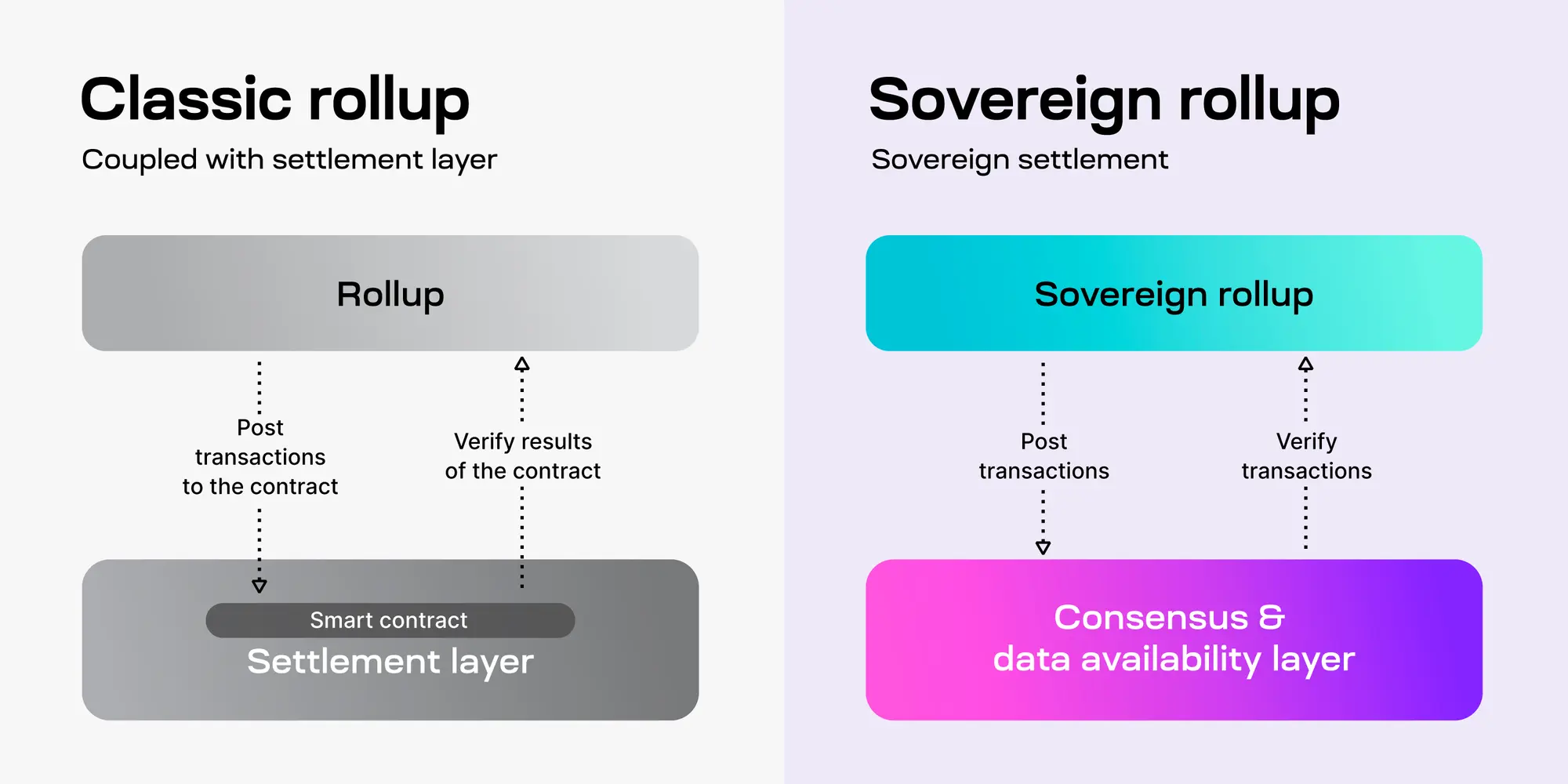
Defining rollup settle mechanics
In the Layer 2 ecosystem, the term rollup settle refers to the final step where a rollup's state is anchored to Layer 1 (L1). This process transforms a claimed state into a trusted one, ensuring that the security guarantees of the main chain protect the assets and transactions occurring off-chain. Without this anchoring, a rollup is merely an isolated database with no cryptographic link to the broader network's consensus.
To understand settlement, it helps to distinguish it from execution and data availability. Execution is the computation of transactions—determining the new state of accounts. Data availability is the publication of the transaction data on L1 so that anyone can reconstruct the state. Settlement is the final verification step. It is the mechanism that resolves disputes or validates proofs, effectively "settling" the outcome on the L1 blockchain.
For Optimistic Rollups, settlement involves a challenge period where anyone can dispute an invalid state transition. For Zero-Knowledge (ZK) Rollups, settlement involves verifying a cryptographic proof that the state transition was valid. In both cases, the L1 contract acts as the ultimate arbiter. This design allows rollups to inherit Ethereum's security model, reducing congestion on the main chain while maintaining trust minimality.
The distinction matters for cross-chain liquidity. When users bridge assets between L2s, they are essentially moving value through the L1 settlement layer. A robust rollup settle mechanism ensures that assets withdrawn from one rollup are securely credited on another, preventing double-spending and state divergence. This reliability is what enables complex DeFi strategies that span multiple Layer 2 networks.
| Feature | Execution | Data Availability | Settlement |
|---|---|---|---|
| Function | Computes transaction outcomes | Publishes transaction data on L1 | Verifies state and resolves disputes |
| Security Source | Off-chain sequencer | L1 data blobs/contracts | L1 consensus and smart contracts |
| Timing | Real-time | Near real-time | After challenge period or proof verification |
Optimistic versus ZK settlement paths
Rollup settlement determines how Layer 2 chains anchor their final state to Ethereum’s Layer 1. While both models bundle transactions off-chain to reduce congestion, they differ fundamentally in how they prove the validity of those transactions before settlement. This distinction creates a trade-off between immediate availability and cryptographic certainty.
Optimistic rollups assume transactions are valid by default and only require proof if a dispute arises. This approach simplifies development and ensures full EVM compatibility, meaning existing smart contracts can migrate without modification. However, this "optimism" introduces a delay: users must wait for the challenge period—typically around seven days—to ensure no one contests the state root before funds are truly finalized. This latency can hinder cross-chain liquidity strategies that require rapid capital movement.
Zero-Knowledge (ZK) rollups take a stricter approach by generating mathematical proofs for every batch of transactions before submitting them to Layer 1. These validity proofs are verified instantly by the Ethereum network, eliminating the need for a challenge window. The result is near-instant finality, which is critical for high-frequency trading and complex cross-chain bridges. The trade-off lies in computational complexity; generating ZK proofs requires significant processing power and specialized cryptographic infrastructure, which can sometimes lead to higher operational costs during network congestion.
The following table compares the core mechanics of these two settlement models, highlighting how their technical differences impact speed, security, and cost.
| Feature | Optimistic Rollup | Zero-Knowledge Rollup |
|---|---|---|
| Finality Time | ~7 days (challenge period) | ~10-20 minutes |
| Proof Mechanism | Fraud proofs (dispute-based) | Validity proofs (cryptography-based) |
| EVM Compatibility | Full (native) | Partial (requires adaptation) |
| Security Model | Relies on economic incentives and monitoring | Relies on cryptographic verification |
| Cost Profile | Lower proof costs, higher latency | Higher proof costs, lower latency |
Shared sequencers and cross-rollup liquidity
The traditional model of cross-chain trading relies on a slow, costly relay: a user swaps on Rollup A, the transaction is submitted to Ethereum Layer 1, and only after that L1 anchor is confirmed can the liquidity be unlocked on Rollup B. This two-step dance creates latency and exposes traders to gas price volatility. Shared sequencers eliminate this bottleneck by acting as a common ordering layer for multiple rollups simultaneously.
When rollups share a sequencer, transactions from different chains are processed in the same block space before they ever touch the settlement layer. This allows for atomic cross-rollup settlements, where a swap on one rollup and a corresponding deposit on another are finalized together. The result is a unified liquidity pool that feels like a single chain to the user, significantly reducing the time and cost of moving assets between ecosystems.
Batch settlement techniques further optimize this process. Instead of anchoring every individual trade to L1, shared infrastructure aggregates these operations, verifying proofs in larger batches. This reduces the computational load on the main chain and increases overall throughput, making high-frequency cross-rollup trading viable.
Impact on cross-chain liquidity in 2026
Faster rollup settlement is fundamentally altering how liquidity moves across the blockchain ecosystem. By anchoring transaction data and proofs to a secure settlement layer like Ethereum, rollups create a unified source of truth. This reduces the need for complex, multi-hop bridges that often fragment liquidity and introduce significant risk. As settlement speeds improve, capital can flow more freely between decentralized exchanges (DEXs) and applications, creating a more integrated market.
The reduction in finality time allows liquidity providers to deploy capital with greater confidence. In 2026, the friction of waiting for confirmations is diminishing, enabling higher frequency trading and more efficient market making. This efficiency is critical for maintaining depth in pools, as capital that was previously tied up in bridge reserves or waiting for dispute windows can now be deployed elsewhere. The result is a more resilient liquidity landscape where volume is less concentrated in a few dominant hubs.
Improved settlement also enhances the viability of cross-rollup interoperability. When each rollup can settle quickly and securely, the trust assumptions required for bridging assets between them weaken. This encourages the development of atomic swap protocols and unified liquidity pools that span multiple rollups. Consequently, DEX volume is likely to see a shift from isolated chains to interconnected networks, where users can access deep liquidity regardless of their preferred execution layer.
No comments yet. Be the first to share your thoughts!