
Defining rollup settle in the modular stack
Settlement is the final, immutable step where a rollup's state is anchored to a base layer. It is the security anchor for Layer 2s, distinguishing itself from execution (processing transactions) and data availability (publishing data). Without settlement, a rollup's state remains unverified and vulnerable to reorganization or fraud.
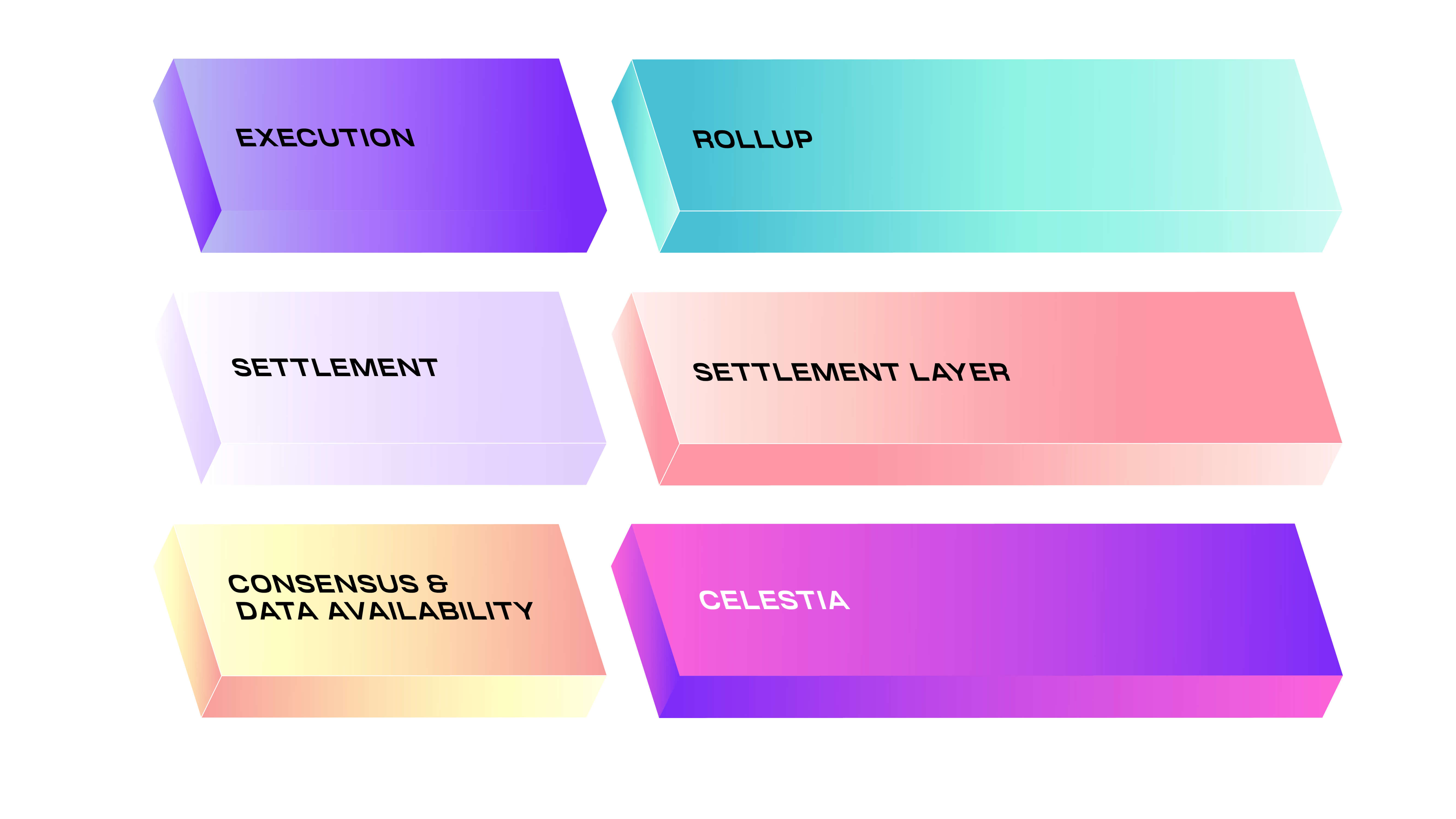
In the modular stack, settlement layers handle proof verification and dispute resolution. While execution and data availability can be offloaded to specialized chains, settlement provides the final guarantee of truth. As noted in Celestia’s documentation, settlement is an optional feature in the modular paradigm, allowing sovereign rollups to use standalone consensus and data availability layers if they choose.
This process replaces traditional intermediaries like banks and clearinghouses with a shared, tamper-resistant ledger. Payments are confirmed in minutes and settled 24/7, removing the need for multiple layers of verification. For analysts, understanding this distinction is critical: execution determines speed, data availability determines transparency, but settlement determines security.
The choice of settlement layer directly impacts a rollup's cost and finality time. Whether using Ethereum as a settlement layer or a specialized sovereign chain, the core function remains the same: providing a single source of truth that all other layers trust.
Tracking L2 settlement costs and fees
Understanding rollup economics requires separating the costs of execution from the costs of settlement. While execution fees cover the computation of transactions, settlement fees cover the final commitment of data and proofs to the base layer. This distinction is critical for analysts modeling the long-term viability of Layer 2 solutions.
Data availability and proof verification
Settlement costs are primarily driven by two factors: data availability (DA) and proof verification. When a rollup posts a batch to Ethereum, it pays for the calldata required to make that data available. Simultaneously, if the rollup uses validity proofs (ZK), it incurs gas costs for verifying those proofs on-chain. If it uses fraud proofs (Optimistic), the costs shift toward the security bond required to challenge invalid states.
According to the Espresso Network architecture, rollups must post batches to the L1 along with proofs that ensure consistency between the execution layer and the settlement layer. This process ensures that the state root is immutable and secure, leveraging the L1's finality. Celestia and other modular DA layers offer alternatives to Ethereum calldata, potentially reducing the data portion of settlement fees, though verification costs on the L1 remain a constant factor.
Fee components breakdown
The economic structure of settlement can be broken down into distinct line items that vary by rollup type and data availability strategy.
| Cost Component | Description | Primary Driver |
|---|---|---|
| Data Availability | Cost of posting transaction data to the base layer. | L1 Gas Prices & Data Size |
| Proof Verification | Gas cost for verifying ZK proofs or managing fraud proof challenges. | Proof Complexity & L1 Compute |
| State Root Commitment | Fixed cost for anchoring the rollup state to the L1 block. | L1 Base Fee |
| Security Bond | Capital locked by challengers in Optimistic rollups. | Risk of Fraud & Capital Cost |
Contextualizing costs with ETH volatility
Settlement fees are denominated in ETH, making them sensitive to Ethereum's market volatility. A spike in ETH price can dramatically increase the USD-denominated cost of settlement, even if the gas units remain stable. This volatility adds a layer of financial risk for rollup operators who must manage treasury exposure.
Tracking these metrics provides a clearer picture of the true cost of L2 finality. By analyzing both the gas mechanics and the ETH price action, analysts can better predict the economic pressures facing rollup operators in 2026.
Compare Optimistic and ZK Rollup Settle Architectures
Settlement architecture defines how a rollup proves its transactions are valid before committing them to a Layer 1 blockchain like Ethereum. This choice dictates the trade-off between finality speed and security assumptions. Optimistic rollups assume validity by default, relying on a challenge period for fraud proofs, while zero-knowledge (ZK) rollups submit cryptographic proofs that guarantee correctness instantly upon verification.
The modular blockchain paradigm introduces further nuance. As noted in Celestia’s documentation, settlement layers are optional in modular setups; sovereign rollups can use standalone consensus and data availability layers, though most mainstream rollups still settle directly on Ethereum for maximum security. The table below contrasts the two dominant settlement models.
| Feature | Optimistic | ZK | Sovereign |
|---|---|---|---|
| Finality Time | 7 days (challenge period) | Minutes to hours | Block time of L1 |
| Security Model | Ethereum L1 fraud proofs | Ethereum L1 validity proofs | Standalone consensus |
| Data Availability | Ethereum blob/calldata | Ethereum blob/calldata | Independent DA layer |
| Complexity | Lower (no ZK circuits) | High (circuit design) | High (full stack) |
For most analysts, the distinction lies in the risk profile. Optimistic rollups offer a familiar security guarantee by inheriting Ethereum’s economic security, but the withdrawal delay impacts liquidity velocity. ZK rollups provide immediate finality, reducing counterparty risk during withdrawals, but require significant computational overhead to generate proofs. Sovereign rollups offer the fastest settlement but sacrifice the shared security of the Ethereum base layer.
Why L2 finality matters for DEX settlement
For decentralized exchanges operating across multiple rollups, settlement finality is not just a security metric; it is the operational backbone of cross-chain liquidity. Unlike centralized exchanges that rely on internal ledgers, DEXs must wait for cryptographic proof of validity before considering a trade irreversible. This wait time dictates how quickly capital can rotate between ecosystems, directly impacting arbitrage efficiency and user experience.
The settlement layer acts as the ultimate arbiter of truth. As defined by Celestia, this layer provides proof verification and dispute resolution for rollups, ensuring that state transitions are tamper-resistant. When a DEX executes a swap on an optimistic rollup, it must wait for the fraud window to close or for a validity proof to be submitted to the settlement layer. Until that moment, the assets remain in a probabilistic state, exposing the protocol to potential reorgs or invalid state claims.
This dependency creates a bottleneck for cross-rollup operations. Transfers between rollups often require bridging assets through a settlement layer, adding latency and complexity. Research into inter-rollup transfer systems highlights that batch settlement techniques can augment efficiency, but the fundamental need for finality remains. Without a shared settlement standard, DEXs face fragmented liquidity pools and increased risk of settlement failures during high-volatility periods.
The practical implication is clear: faster finality leads to tighter spreads and higher capital efficiency. Protocols that optimize their settlement strategies—whether by leveraging faster finality providers or optimizing batch sizes—gain a competitive edge. For analysts, monitoring the finality times of major rollups is as critical as tracking trading volume, as it directly correlates with the reliability of cross-chain DEX operations.
No comments yet. Be the first to share your thoughts!