
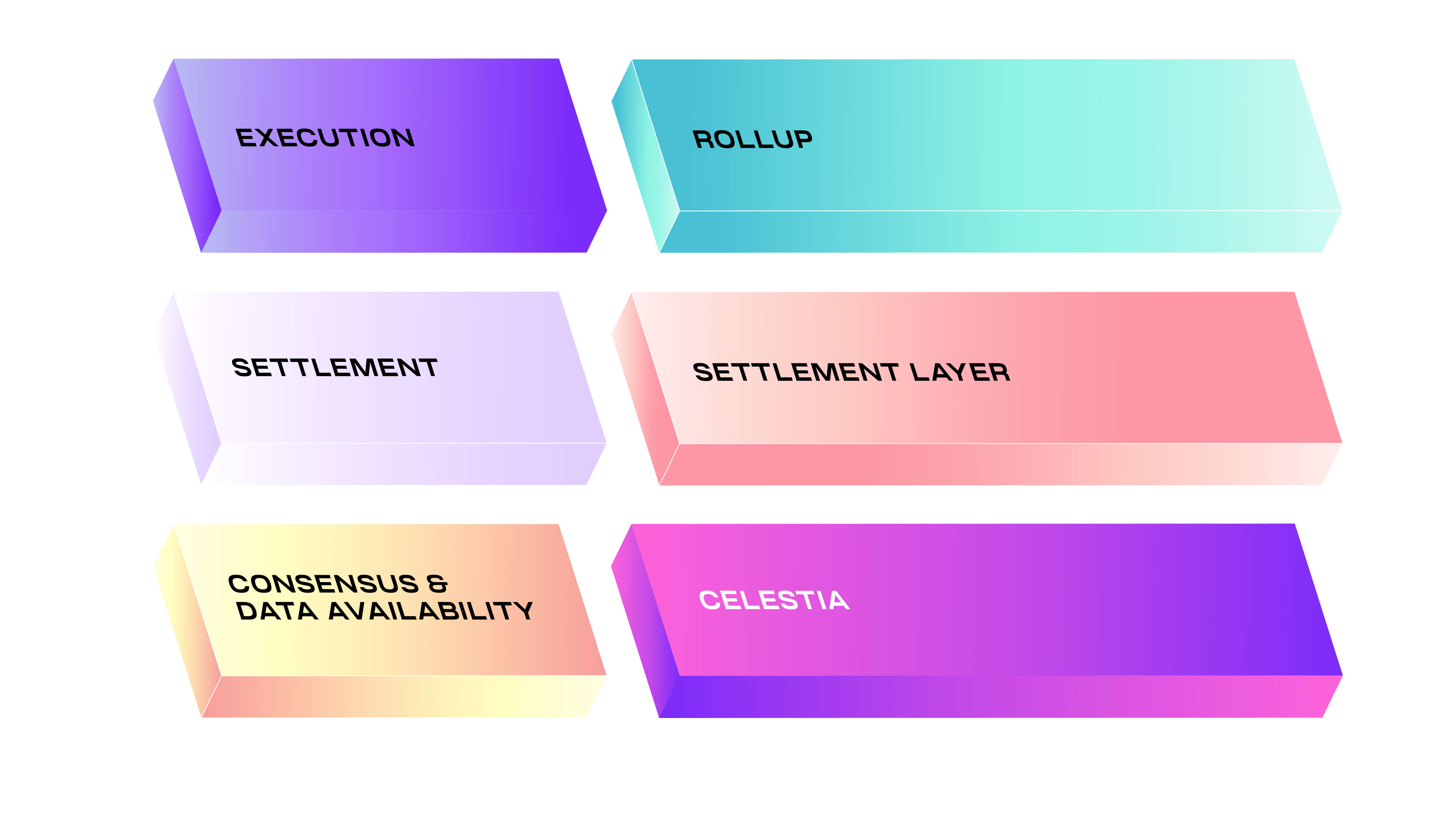
What is rollup settle?
Rollup settlement is the final step in a modular blockchain transaction. It is the process where a Layer 2 chain proves its state to a Layer 1 blockchain, ensuring that the transactions are final, immutable, and secure. While execution happens off-chain to process transactions quickly, and data availability ensures the data is published, settlement is what anchors that activity to the main chain’s security.
In the modular stack, settlement acts as the ground truth. It resolves disputes and finalizes withdrawals. Without settlement, a rollup is just an isolated database. The Layer 1 chain verifies the validity proofs or fraud proofs submitted by the rollup, confirming that the state transition was correct. This verification is what gives users confidence that their assets are safe.
Settlement layers are not always mandatory in the same way execution is. Sovereign rollups, for example, can use a standalone consensus and data availability layer, relying less on a traditional Layer 1 for finality. However, most popular rollups settle on Ethereum, inheriting its robust security model. This inheritance is why settlement is critical: it ties the rollup’s efficiency to the Layer 1’s trustlessness.
The cost of settlement is a primary driver for rollup adoption. By batching thousands of transactions into a single proof, rollups spread the Layer 1 gas cost across many users. This reduces the cost per transaction significantly compared to executing directly on the main chain. Settlement, therefore, is not just a technical formality; it is the economic mechanism that makes scaling possible.
Optimistic vs ZK settlement costs
The choice between optimistic and zero-knowledge rollups comes down to how they handle the final step of settlement. Both models bundle transactions off-chain to save space, but they differ sharply on how they prove those transactions are valid to the Layer-1 chain. This verification step determines the cost per batch and the time it takes for a transaction to be considered final.
Optimistic rollups assume transactions are valid by default. They post the transaction data to Ethereum and wait for a challenge period, typically seven days, before finalizing the state. This approach keeps daily operational costs low because it doesn't require complex cryptographic proofs for every batch. However, the seven-day finality window is a significant trade-off for users who need immediate access to their funds.
Zero-knowledge (ZK) rollups take the opposite approach. They generate a cryptographic proof that mathematically verifies the validity of the entire batch before submitting it to the chain. This eliminates the need for a challenge period, allowing for near-instant finality. The trade-off is computational complexity; generating these proofs requires more intensive resources, which can make the cost per batch higher during periods of high network congestion.
The following table compares the core economic and technical metrics that drive these differences.
| Metric | Optimistic Rollup | ZK Rollup | User Impact |
|---|---|---|---|
| Finality Time | 7 days (challenge period) | Minutes to hours | ZK allows immediate withdrawal; Optimistic requires waiting. |
| Proof Generation | None (assumed valid) | Complex cryptographic proof | ZK requires more computational overhead. |
| Settlement Cost | Lower per batch | Higher per batch | Optimistic is cheaper for high-volume, low-value txs. |
| Security Model | Economic (slashing) | Cryptographic | ZK offers stronger mathematical guarantees. |
When evaluating rollup settlement costs, it is important to look beyond the immediate gas fees. Optimistic rollups are often more economical for simple transfers because they avoid the heavy computational cost of proof generation. ZK rollups, while currently more expensive to settle, are rapidly improving in efficiency as proof-generation algorithms become more optimized.
For applications requiring instant finality, such as decentralized exchanges or real-time gaming, the higher cost of ZK settlement is often justified by the speed. Conversely, for long-term storage or low-frequency transactions, the lower cost of optimistic settlement may be the preferred economic model. As both technologies mature, the gap in settlement costs is expected to narrow, but the fundamental trade-off between speed and verification complexity will remain.
Shared Sequencers for Cross-Rollup Settlement
When you trade on a decentralized exchange, the friction often comes from the settlement layer. Traditionally, every rollup posts its own data batches to Ethereum. This redundancy bloats the data availability layer and drives up fees for everyone. Shared sequencer infrastructure changes this by allowing multiple rollups to route their transaction ordering through a single, coordinated network.
This architecture enables efficient cross-rollup DEX settlement. Instead of settling trades on separate chains and then bridging assets—a process that requires multiple confirmations and high gas fees—shared sequencers can process the entire trade lifecycle. They order the execution on one rollup and the settlement on another within the same batch. This eliminates the need for redundant data posting, significantly lowering the marginal cost of complex DeFi operations.
The technical mechanism relies on batch settlement techniques. As documented in research on efficiency-improved inter-rollup transfer systems, leveraging batch settlement allows for augmented efficiency in transfers between rollups [1]. The shared sequencer aggregates these transactions, ensuring that the state transitions are consistent across the involved rollups before the final proof is submitted to the Layer-1 chain.
This approach mirrors how traditional financial markets operate. In legacy finance, a trade between two parties is settled through a central clearinghouse that nets out obligations, rather than each party posting collateral to a separate ledger. Shared sequencers act as that clearinghouse for rollups, reducing the computational and data overhead required to finalize a trade.
For investors and developers, the implication is a more unified liquidity landscape. Cross-rollup settlement means that liquidity doesn't have to be siloed on individual chains. A user on an Optimistic Rollup can trade against a liquidity pool on a ZK-Rollup with near-instant finality and minimal fees, as the shared sequencer handles the complexity of cross-chain state verification.
| Feature | Traditional Cross-Chain | Shared Sequencer |
|---|---|---|
The result is a more efficient market structure. By removing the bottleneck of redundant data availability, shared sequencers allow cross-rollup DEX settlement to compete with centralized exchanges on speed and cost, while retaining the security benefits of Layer-1 finality.
[1] Efficiency-Improved Inter-Rollup Transfer System Leveraging Batch Settlement, arXiv:2305.19514
Rollup settle in 2026: fee reduction trends
The cost of rolling up transactions is dropping, but the real story for 2026 is how settlement efficiency translates to lower fees for end-users. As Layer 2s mature, the gap between what the network pays to settle on Ethereum and what the user pays for a transaction is narrowing. This isn't just about cheaper gas; it's about the mechanics of how data and proofs are priced on the settlement layer.
Settlement fees have historically been the biggest variable in rollup economics. When Ethereum mainnet congestion spikes, the cost to post a single rollup batch can balloon, forcing Layer 2 operators to pass those costs to users. In 2026, improved settlement efficiency means rollups are better at batching and compressing data before it hits the main chain. This reduces the "settlement overhead"—the fixed cost of verification and state root commitments that gets distributed across every transaction. Polynya breaks down how these distinct fee layers interact, showing that as data fees stabilize, the settlement portion becomes a smaller fraction of the total cost.
The visual reality of these costs is best seen in real-time market data. The widget below shows current ETH gas prices, which serve as the baseline for all Layer 2 settlement costs. When gas is high, even efficient rollups feel expensive. When gas is low, the benefits of rollup compression are most visible to the user.
Looking ahead, the trend points toward a decoupling of user fees from mainnet volatility. As settlement layers become more specialized and data availability solutions improve, the marginal cost of adding one more transaction to a rollup batch approaches zero. This means that in 2026, a user sending $10 or $10,000 should pay roughly the same fee, because the settlement cost is fixed per batch, not per transaction. This is the core promise of rollup settle: predictable, low-cost finality that doesn't spike with network demand.
The TechnicalChart below provides a broader view of Ethereum's price action, which often correlates with gas fee volatility. Understanding this relationship helps explain why settlement efficiency matters—when the underlying asset is volatile, the cost of securing it on-chain fluctuates, making efficient rollup batching more critical for maintaining stable user fees.
Common questions about rollup settlement
Blockchain settlement is the final step in a transaction, ensuring assets or funds are securely transferred between parties. In the context of Layer 2, this means posting aggregated data and proof to a base Layer-1 chain like Ethereum. This process guarantees that the state updates are immutable and verified by the underlying network's security.
There are two main types of rollups: Optimistic Rollups and ZK-Rollups. Optimistic rollups assume transactions are valid unless proven otherwise, relying on fraud proofs. ZK-Rollups use zero-knowledge proofs to mathematically verify validity instantly. Both types bundle transactions off-chain to reduce congestion and lower costs while inheriting the security of the settlement layer.
A rollup in crypto is a scaling solution that aggregates multiple transactions into a single batch. This batch is then posted to a Layer-1 blockchain, which handles the final settlement and data availability. By moving computation off-chain, rollups allow users to interact with faster, cheaper dApps while maintaining the trustlessness and security of the base layer.
No comments yet. Be the first to share your thoughts!