
Defining rollup settle mechanics
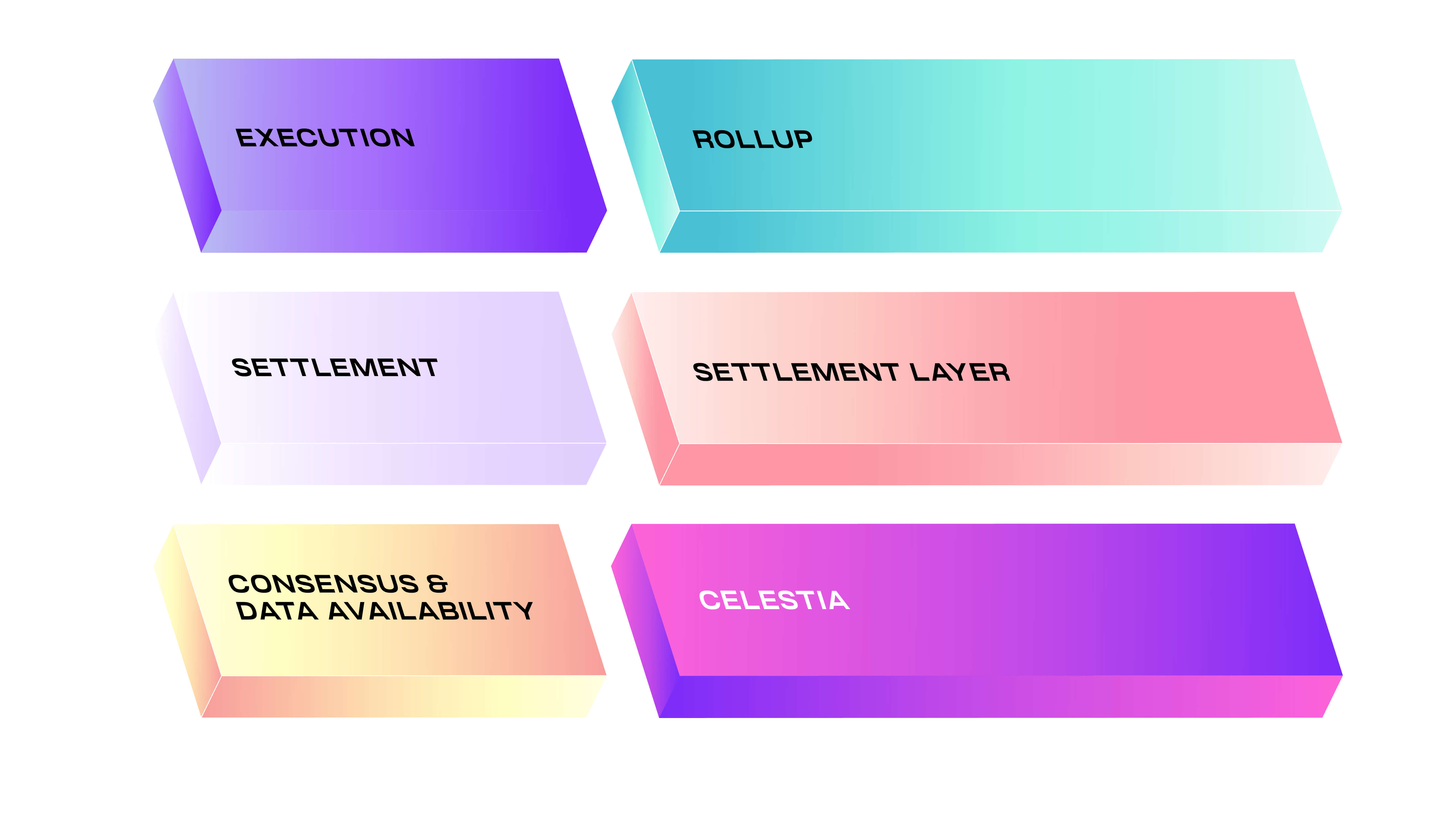
To understand the 2026 market, you must separate execution from settlement. In Layer-2 rollup architecture, execution is where transactions happen. Sequencing is where they are ordered. Settlement is where they become final.
Settlement is the act of posting transaction data and cryptographic proofs to a base Layer-1 chain, such as Ethereum. This layer does not process the logic of every trade or transfer. Instead, it validates the batch. It ensures the rollup state is consistent and secure. Without this anchor, the rollup is just a database.
This distinction is critical for risk assessment. Execution happens off-chain for speed. Settlement happens on-chain for truth. The security of the entire rollup depends on the Layer-1 consensus. If the settlement layer is compromised, the rollup's assets are at risk. This is why smart contract rollups publish their entire blocks to a settlement layer like Ethereum. The L1's job is to order and verify, not to compute. Source: Celestia.org
The cost of this security is gas. Every time a rollup settles, it pays L1 fees. This creates a direct link between L1 congestion and L2 economics. When Ethereum is busy, settlement becomes expensive. This pressure forces rollups to optimize their batch sizes and proof types.
Technical Context: Ethereum Security
The reliability of rollup settlement is tied directly to Ethereum's health. A drop in ETH price or a spike in network activity can disrupt L2 economics. The following chart shows the current ETH/USD price action, which serves as the baseline for settlement costs.
Settlement is not just a technical step; it is the finality mechanism. It is the moment a transaction becomes immutable. For markets, this immutability is the product. Execution provides liquidity; settlement provides trust. The two are inseparable in a rollup model.
How optimistic rollups settle transactions
Optimistic rollups achieve finality by assuming all offchain transactions are valid until proven otherwise. This model batches thousands of transactions offchain and posts the compressed data to Ethereum Layer 1. The "optimistic" name comes from this default trust assumption, which allows for significantly higher throughput and lower fees compared to executing every computation on the main chain. However, this speed comes with a security trade-off: the system relies on a challenge period to detect and reject invalid state transitions.
The core security mechanism is the fraud proof. When a rollup operator posts a new state root, a 7-day challenge window begins. During this time, any network participant can review the transaction data. If they detect an invalid execution—such as a fraudulent state transition—they can submit a fraud proof. This proof initiates a dispute resolution process on Ethereum mainnet, effectively reverting the invalid state and penalizing the malicious operator. This mechanism ensures that the finality of the rollup is anchored to the security of Ethereum, even though the computation happens offchain.
This settlement model creates a distinct risk profile for market participants. While the 7-day delay might seem like a bottleneck, it provides a critical verification layer that prevents immediate finality errors. For high-stakes financial applications, this delay is a necessary buffer against state corruption. Understanding this settlement latency is essential for evaluating the reliability of Layer 2-based financial products in 2026.
ZK-rollup cryptographic finality
Optimistic rollups operate on a presumption of honesty, requiring a seven-day challenge period before funds can be withdrawn. This delay creates a window of vulnerability for users seeking immediate liquidity. ZK-rollups eliminate this waiting game by relying on validity proofs—cryptographic evidence that a batch of transactions is correct. Once the proof is verified on Layer 1, finality is instant.
This shift from "assume valid, verify if challenged" to "verify before accepting" changes the risk profile for market participants. In high-stakes trading environments, the ability to settle and withdraw without delay reduces counterparty risk and capital inefficiency. The cryptographic guarantee replaces the need for active monitoring or dispute resolution.
| Feature | Optimistic Rollup | ZK-rollup |
|---|---|---|
| Finality Time | ~7 days (challenge period) | Immediate upon verification |
| Proof Generation | None (fraud proofs on dispute) | Zero-knowledge validity proofs |
| Security Model | Economic incentives & slashing | Cryptographic correctness |
The cost of generating these proofs remains higher than generating fraud proofs, but the tradeoff favors speed and certainty. As seen with networks like zkSync, this architecture allows for faster settlement cycles, aligning better with traditional finance expectations for immediate finality. The market is beginning to price this efficiency into ZK-rollup valuations, distinguishing them from their optimistic counterparts.
| Metric | Optimistic | ZK-rollup |
|---|---|---|
| Finality | 7 days | Immediate |
| Proof Type | Fraud | Validity |
| Security Assumption | Honesty | Mathematics |
Settlement costs and fee structures
The economics of rollup settlement are not monolithic; they are split between the cost of data and the cost of proof. Understanding this split is essential for predicting how Layer-2 networks will compete for market share in 2026. As Ethereum’s base layer evolves, the marginal cost of settling transactions on-chain determines which rollups can survive with thin margins.
Data availability and EIP-4844
The primary driver of settlement costs for most rollups is data availability. Before EIP-4844 (Proto-Danksharding), posting calldata to Ethereum was prohibitively expensive, often costing hundreds of dollars per block. EIP-4844 introduced "blobs," a cheaper data format that reduced these fees by roughly 90%. Today, the bulk of a rollup’s settlement cost is simply the price of renting blob space.
This cost is volatile and tied directly to Ethereum gas prices. When network congestion spikes, blob fees rise, squeezing rollup profitability. For optimistic rollups, this is the only major on-chain cost. For zero-knowledge rollups, it is the dominant cost, though they still incur minor overhead for proof verification.
Proof verification costs
Zero-knowledge rollups face an additional layer of cost: proof verification. While they benefit from lower data requirements because they post succinct cryptographic proofs rather than raw transaction data, they must pay gas to verify these proofs on Ethereum mainnet. The cost of verification depends on the type of ZK proof used (e.g., STARKs vs. SNARKs) and the efficiency of the verification circuit.
Optimistic rollups avoid this verification cost entirely by assuming transactions are valid unless challenged. However, they face a trade-off: longer withdrawal periods (typically 7 days) to allow for fraud proofs. This latency affects user experience but keeps immediate settlement fees low. As ZK technology matures, verification costs are expected to drop, potentially making ZK rollups cheaper than optimistic ones for high-volume applications.
The fee structure in practice
For users, these costs are bundled into the transaction fees they pay. A rollup’s total fee is essentially: Rollup Operator Fee + Data Availability Fee + Verification Fee (if ZK). The rollup operator sets the base fee to cover their costs and generate margin, while the data and verification fees are variable costs passed through from Ethereum.
Shared Sequencers and Cross-Rollup Settlement
The fragmentation of liquidity across isolated rollup ecosystems is a structural inefficiency that shared sequencers are designed to resolve. By routing transactions from multiple rollups through a single ordering layer, these infrastructure components enable atomic settlement. This means that complex multi-step operations—such as swapping tokens across different chains or bridging assets—can be executed in a single cryptographic proof rather than requiring sequential, latency-prone handshakes between independent validators.
This architecture transforms the settlement layer from a passive ledger into an active coordination mechanism. Instead of relying on bridge contracts that lock and unlock assets with inherent security gaps, shared sequencers allow rollups to settle state transitions simultaneously. The result is a unified liquidity pool where capital efficiency improves because funds are not idle during cross-chain transit. Latency drops from seconds to milliseconds, a critical threshold for high-frequency trading and arbitrage opportunities that previously vanished due to execution delays.
The implications for decentralized exchange (DEX) markets are immediate. When settlement becomes atomic, the risk of front-running and sandwich attacks diminishes because the entire transaction bundle is processed as one unit. Liquidity providers face less impermanent loss volatility during cross-chain swaps, encouraging deeper order books. As shared sequencing infrastructure matures, it effectively merges the fragmented rollup landscape into a cohesive market, where price discovery happens across the entire ecosystem rather than within siloed chains.
Key questions on rollup finality
Understanding rollup mechanics is essential for evaluating market liquidity and settlement risk. These answers clarify the structural differences between Layer 2 architectures and their underlying security models.
| Feature | Rollup | Sidechain |
|---|---|---|
| Security Model | Relies on Ethereum L1 | Independent consensus |
| Data Availability | Posted to L1 | Managed independently |
| Finality Speed | Depends on proof type | Fast independent blocks |
No comments yet. Be the first to share your thoughts!