
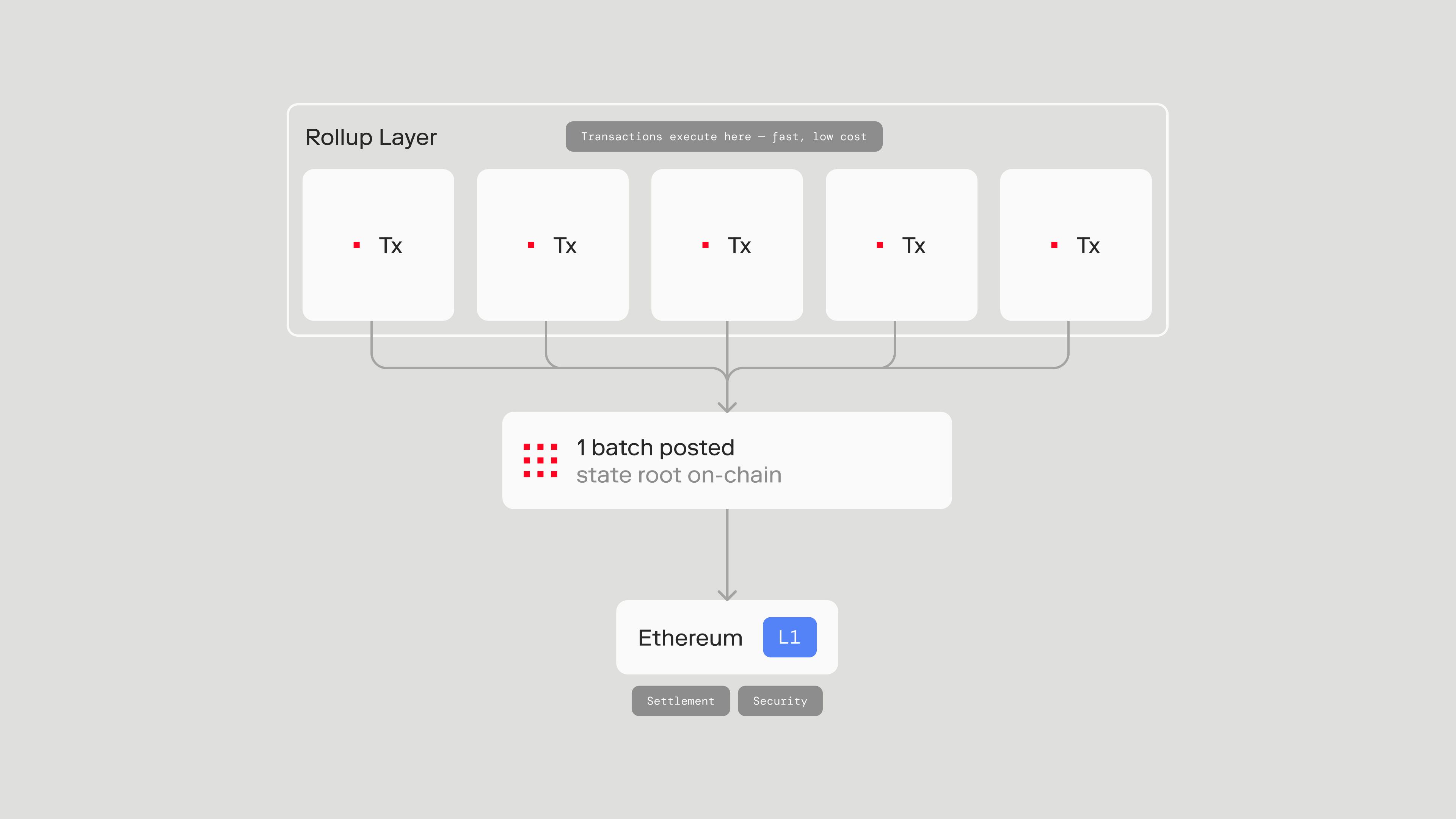
What rollup settlement means
In the rollup stack, settlement is the final step where a rollup posts data and proofs to a Layer 1 chain to guarantee security. This process anchors the rollup to Ethereum’s security model, ensuring that all transaction data and validity proofs are permanently recorded on the base layer. Without this anchor, a rollup operates in isolation, lacking the cryptographic guarantees that define a secure blockchain network.
Settlement is distinct from execution and sequencing. Execution involves processing transactions and updating state, while sequencing orders those transactions for efficiency. Settlement, however, is the act of finalizing that work. It is the moment the rollup’s state becomes immutable and verifiable against the L1. This separation allows rollups to scale execution independently while inheriting the robustness of the underlying chain.
For cross-rollup decentralized exchanges, settlement is the critical link that enables trustless interoperability. When multiple rollups settle on the same L1, they share a common source of truth. This shared finality allows assets to move between rollups without relying on centralized bridges or third-party validators. The integrity of the entire ecosystem depends on the reliability and speed of this settlement layer.
Smart contract rollups publish their entire blocks to this settlement layer, such as Ethereum, to ensure data availability and security. By doing so, they leverage the economic security of the main chain, making it prohibitively expensive for malicious actors to alter transaction history. This model balances scalability with the security standards expected in high-stakes financial applications.
Optimistic vs ZK settlement mechanics
Both optimistic and zero-knowledge (ZK) rollups inherit Ethereum’s security for settlement and data availability because all proof and transaction data is anchored to Layer 1. However, they achieve this finality through fundamentally different cryptographic approaches, resulting in distinct user experience trade-offs regarding speed and complexity.
Optimistic Rollups: Fraud Proofs
Optimistic rollups, such as Optimism and Base, operate on the assumption that all transactions are valid by default. This "optimistic" approach minimizes on-chain computation by posting only transaction data to Ethereum, deferring the heavy lifting to off-chain sequencers.
Security is maintained through a 7-day challenge window. If a malicious actor submits incorrect state roots, anyone can submit a fraud proof to revert the invalid transactions. This mechanism means users must wait for the challenge period to expire before funds are considered truly final and withdrawable.
ZK Rollups: Validity Proofs
ZK rollups, including zkSync and Scroll, take the opposite approach by generating a cryptographic validity proof for every batch of transactions. This proof, known as a zk-SNARK or zk-STARK, mathematically certifies that the state transition was executed correctly according to Ethereum’s rules.
Because validity is proven on-chain rather than assumed, ZK rollups offer near-instant finality. There is no waiting period for fraud proofs; once the proof is verified by the smart contract, the settlement is final. This eliminates the withdrawal delay inherent to optimistic models.
Settlement Comparison
The table below contrasts the core mechanical differences between these two settlement layers.
| Feature | Optimistic Rollup | ZK Rollup |
|---|---|---|
| Proof Type | Fraud Proofs | Validity Proofs |
| Finality Time | ~7 Days | ~Minutes |
| On-Chain Cost | Lower | Higher |
| Complexity | Standard | High |
Market Context
The choice between settlement types often influences the underlying asset's liquidity and trading volume. Traders analyzing these L2 ecosystems frequently monitor the performance of the native tokens associated with these networks.
Settlement costs and data availability
The economics of settling a rollup on a base layer are driven by two competing forces: the cost of posting data and the volume of transactions sharing that data. Before the implementation of EIP-4844, known as proto-danksharding, data availability was prohibitively expensive for high-throughput networks. The introduction of blobs reduced the cost of storing this data by approximately 90%, fundamentally altering the fee structure for both optimistic and ZK rollups. This reduction made high-frequency settlement viable, shifting the bottleneck from raw storage costs to the efficiency of the rollup's compression algorithms.
However, lower base costs do not automatically mean lower fees for the end user. The final cost per transaction is inversely proportional to activity. As more users transact through a rollup, the fixed cost of posting a block of data is spread across a larger number of transactions, driving down the individual fee. This dynamic is particularly challenging for newer or less active ZK rollups, which lack the critical mass of users to amortize these data availability costs effectively. In contrast, established optimistic rollups often benefit from higher throughput, allowing them to offer cheaper settlement despite less efficient proof generation.
The divergence in settlement strategies creates a distinct economic profile for each type. Optimistic rollups rely on the security of the base layer's fraud proof window, meaning their data availability costs are primarily determined by the size of the calldata they post. ZK rollups, while generating smaller data payloads due to compact zero-knowledge proofs, must cover the computational cost of generating those proofs. As the market matures, the winner in low-cost settlement will likely be the architecture that can best balance proof generation efficiency with the ability to attract the transaction volume necessary to dilute data posting fees.
Finality speed and user experience
The choice between optimistic and ZK rollups fundamentally alters how users interact with capital. For traders and institutional operators, the difference between waiting days or seconds for settlement is not a technical nuance; it is a liquidity constraint. Optimistic rollups prioritize throughput and cost-efficiency by assuming transactions are valid, relying on a seven-day challenge period to prove fraud. This model works well for passive storage or long-term holding, but it creates friction for active trading. A user withdrawing funds from an optimistic rollup must endure this delay, effectively locking capital in a limbo state where it cannot be deployed elsewhere or secured off-chain.
ZK rollups solve this latency problem through cryptographic proof. Instead of waiting for a challenge window to close, ZK rollups generate a validity proof that instantly verifies the state transition on Ethereum. This means withdrawals can be initiated and settled in minutes, not weeks. The user experience shifts from a "wait-and-see" model to an instant settlement model. For cross-rollup swaps, where capital must move between different layer-2 networks, this speed is critical. Near-instant finality allows for atomic-like operations across ecosystems, reducing the risk of price slippage and exposure to market volatility during transit.
However, this speed comes with trade-offs. The computational cost of generating ZK proofs is higher, which can impact gas fees during peak congestion. Optimistic rollups remain the more economical choice for high-frequency, low-value transactions where the delay is acceptable. As the ecosystem matures, the distinction will blur for casual users, but for high-stakes finance, finality speed remains the primary differentiator. The ability to move capital instantly without trusting a sequencer's honesty defines the next generation of decentralized finance infrastructure.
Shared Sequencers and Cross-Rollup DEXs
The fragmentation of liquidity across distinct rollup chains has historically forced cross-chain trading through slow, expensive bridges. A new infrastructure layer is emerging to solve this: shared sequencers. By allowing multiple rollups to settle against a common Layer 1 ordering mechanism, these systems reduce latency for cross-chain trading and create a unified liquidity pool.
This approach, often termed "based rollups" or L1-sequenced rollups, shifts the sequencing responsibility from individual rollup operators to the base Layer 1. As discussed in foundational Ethereum research, this model leverages the security and ordering guarantees of the main chain to coordinate transactions across different rollup instances. The result is a more cohesive ecosystem where assets move with near-instant finality.
For decentralized exchanges (DEXs), this infrastructure is transformative. Instead of relying on atomic swaps across separate chains, DEXs can now operate across a shared sequencer network. This reduces slippage and improves capital efficiency for traders. The market is beginning to reflect this structural shift, with trading volumes increasingly consolidating on platforms that support this unified settlement layer.
Choosing a settlement model for 2026
Selecting between optimistic and ZK rollups requires balancing execution speed, finality time, and cost. Your choice depends on whether you prioritize immediate user feedback or cryptographic security guarantees.
Optimistic rollups assume transactions are valid unless challenged. This model offers lower upfront costs and higher throughput but requires a seven-day withdrawal window for security. It suits applications where users can tolerate delayed finality, such as decentralized exchanges or gaming platforms that prioritize low transaction fees.
ZK rollups generate cryptographic proofs for every batch. This approach provides instant finality and faster withdrawals, as validity is verified on-chain without a dispute period. However, the computational cost of generating zero-knowledge proofs remains higher. This model is ideal for high-value transfers or applications requiring immediate, verifiable settlement.
| Feature | Optimistic | ZK |
|---|---|---|
| Finality | ~7 days | Instant |
| Cost | Lower | Higher |
| Security | Fraud proofs | Validity proofs |
Common rollup: what to check next
Investors and developers frequently ask how rollups actually function and how they differ from one another. Understanding these mechanics is essential for evaluating the security and cost-efficiency of Layer 2 solutions in 2026.
No comments yet. Be the first to share your thoughts!