
The fragmentation problem in 2026
Isolated rollups have created a liquidity silo problem that hurts capital efficiency across the ecosystem. Each Layer 2 chain operates as a distinct liquidity pool, forcing users to bridge assets repeatedly and traders to manage fragmented order books. This fragmentation increases transaction costs and reduces the depth available for large trades, making the user experience clunky compared to centralized exchanges or unified chains.
The market is shifting because this isolation contradicts the goal of a unified Ethereum. As noted in recent industry analysis, the era of the rollup-centric model is ending as chains prioritize aggregation over isolation. By decentralizing sequencers or becoming fully native rollups, teams often sacrifice the very benefits—upgrade speed and regulatory flexibility—that made them attractive in the first place.
Liquidity fragmentation reduces capital efficiency across isolated Layer 2 ecosystems.
The solution lies in shared sequencers and aggregation layers that treat liquidity as a shared resource rather than a walled garden. Instead of each rollup competing for a slice of the same user base, shared infrastructure allows for seamless asset movement and unified pricing. This shift from fragmentation to aggregation is critical for scaling Ethereum to mass adoption, ensuring that users can access deep liquidity without navigating a maze of bridges and chains.
Shared sequencers as the new standard
The current layer-2 landscape is fractured. Each rollup operates its own sequencer, creating isolated islands of liquidity and conflicting transaction ordering. This fragmentation forces users to navigate complex bridges and pay higher fees to move assets between chains. The industry is now shifting toward shared sequencers to unify this fragmented ecosystem.
Shared sequencers act as a common highway for all rollups. Instead of each chain building its own road, they share a single, high-performance ordering layer. This "Based Rollup" model, championed by projects like Base, ensures that transaction sequencing is aligned with Ethereum's security and governance. By centralizing the ordering process, shared sequencers eliminate the silos that have hindered cross-chain interaction.
This architectural change transforms how rollups settle. Transactions are ordered consistently across all chains before being posted to Ethereum. This uniformity reduces finality times and ensures that state transitions are predictable and fair. The result is a more cohesive network where liquidity flows freely, and users experience the simplicity of a single chain without sacrificing the benefits of layer-2 scalability.
The move toward shared sequencing represents a maturation of the layer-2 space. It prioritizes network-wide efficiency over individual chain autonomy. As more rollups adopt this model, the distinction between different layer-2s will blur, creating a unified settlement layer that is both secure and scalable. This convergence is essential for achieving the next phase of Ethereum's growth.
How aggregation layers bundle rollup transactions
Shared sequencers solve the fragmentation problem by acting as a central hub for multiple rollups. Instead of each layer-2 network processing and posting data independently, a shared sequencer collects transactions from different rollups, orders them, and bundles them into a single batch for Ethereum. This approach treats the settlement layer not as a bottleneck, but as a unified record-keeping system.
The process begins with transaction collection. A shared sequencer receives transactions from various rollup clients simultaneously. It then sorts these transactions based on priority and fee markets, ensuring that high-value transfers are processed efficiently. By handling this ordering centrally, the sequencer eliminates the need for each rollup to compete for block space individually on Ethereum.
Once ordered, the sequencer compresses the data. It bundles transactions from multiple rollups into a single proof or data commitment. This aggregation reduces the amount of data that needs to be posted on Ethereum, significantly lowering gas costs. The efficiency gain comes from sharing the fixed cost of block space across many different users and networks.
Finally, the aggregated data is posted to Ethereum. The settlement layer verifies the proofs and updates the state roots for all involved rollups. This simultaneous settlement ensures that all rollups remain synchronized with Ethereum’s security guarantees. Users benefit from faster finality and lower fees, while the network maintains a single source of truth.
| Feature | Isolated Settlement | Aggregated Settlement |
|---|---|---|
| Gas Cost | High (full block cost per rollup) | Low (shared block cost) |
| Latency | Variable (contention) | Predictable (ordered batching) |
| Security | Dependent on individual rollup | Unified Ethereum security |
- Verify sequencer decentralization to avoid single points of failure.
- Check if the rollup supports zero-knowledge proofs for stronger security.
- Monitor gas fees during peak times to assess aggregation benefits.
- Ensure the settlement layer is Ethereum mainnet for maximum security.
Stablecoin settlement momentum
Stablecoin settlement has moved from experimental pilots to a core infrastructure layer for global finance. Visa’s latest update confirms this shift, with its stablecoin settlement pilot reaching a $7 billion run rate in the first quarter of 2026. This 50% quarter-over-quarter growth signals that institutional players are no longer testing the waters—they are committing capital to blockchain-based rails.
The speed and cost advantages of shared sequencers make them ideal for this volume. Traditional cross-border payments often take days and incur high fees. Stablecoins settle in seconds on rollup layers, reducing friction for merchants and consumers alike. Visa’s expansion to five additional stablecoin issuers underscores the industry’s move toward a multi-asset settlement standard rather than a single-coin monopoly.
"Stablecoins are becoming the new global payment layer, offering faster settlement and lower costs than legacy systems."
The Bitcoin Foundation notes that 2026 is the year blockchain infrastructure finally meets the reliability standards required by traditional finance. As shared sequencers resolve fragmentation, the network effects of stablecoin adoption will likely accelerate, making real-time, low-cost settlement the norm rather than the exception.
For context on how rollups differ from sidechains in this context, it helps to remember that rollups inherit Layer 1 security. This makes them the preferred choice for high-value stablecoin transactions where trust minimization is critical. Sidechains, while faster, operate with independent security models that many institutional investors still view as risky for large-scale settlement.
Key rollup projects to watch
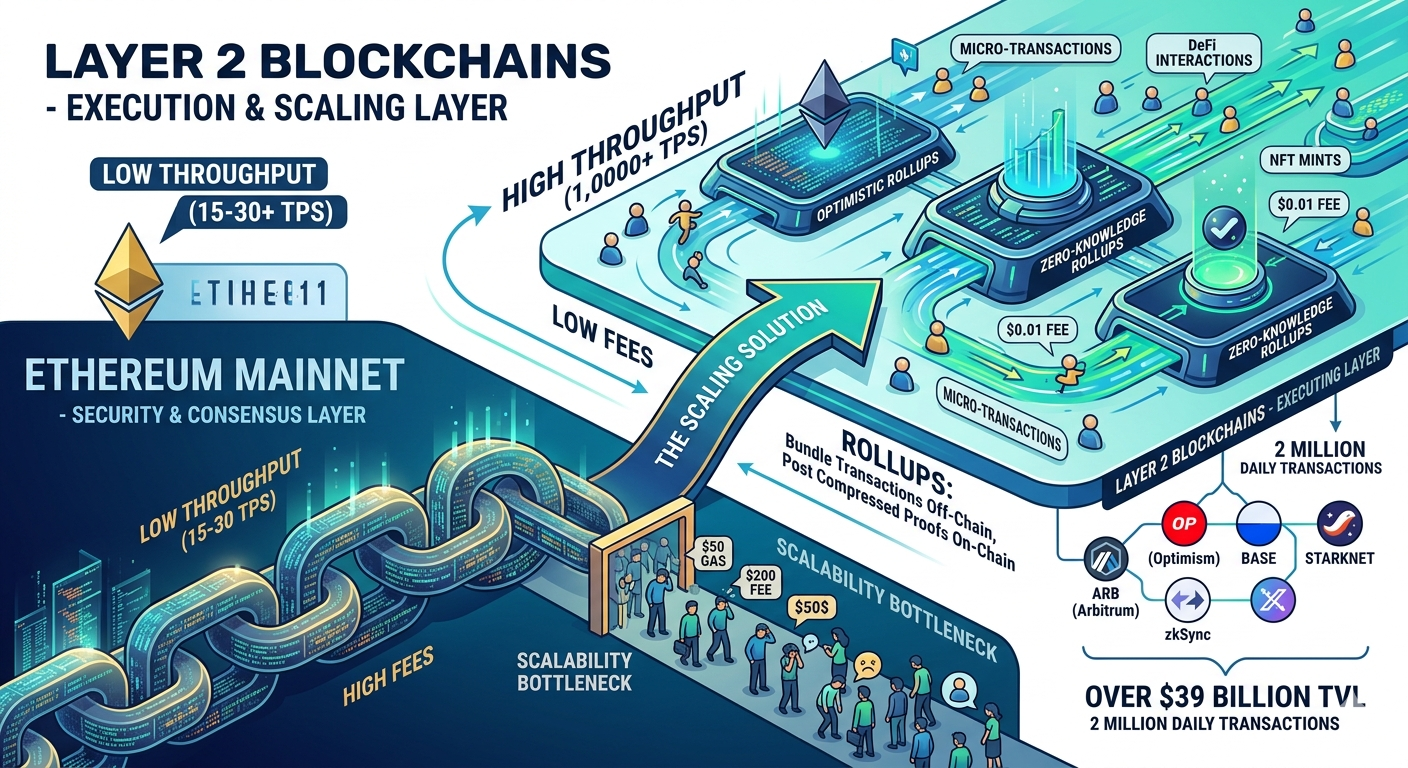
The 2026 settlement revolution relies on two dominant rollup architectures: optimistic and zero-knowledge (ZK) rollups. Each solves fragmentation differently by batching transactions off-chain and settling proof data on Ethereum. Optimistic rollups assume validity until challenged, while ZK rollups generate cryptographic proofs that verify correctness instantly.
Optimistic rollups like Arbitrum and Optimism prioritize developer familiarity by mimicking the Ethereum Virtual Machine (EVM). They delay fraud proofs for a seven-day window, allowing users to withdraw funds without waiting for complex verification. This approach lowers the barrier for existing dApps to migrate, though it introduces latency for finality. Eco provides a detailed breakdown of how these delays impact user experience.
ZK rollups, including projects like zkSync and StarkNet, focus on speed and security by generating succinct proofs that the state transition is valid. They reduce gas fees by up to 99% compared to Layer 1, making them ideal for high-frequency trading and micro-transactions. The trade-off is higher computational complexity for sequencers, but the instant finality appeals to institutional users requiring immediate settlement. ZK Rollups tracks the leading ZK projects advancing this technology.
Rollups vs sidechain security
The distinction between rollups and sidechains often causes confusion, but the difference comes down to where trust resides. Rollups provide high security by leaning on Layer 1s, while sidechains prioritize speed and cost-effectiveness with independent operations. Understanding this split is essential for evaluating risk in 2026.
Rollups: Security by Inheritance
An optimistic rollup batches thousands of transactions offchain and posts the compressed data to Ethereum. It assumes transactions are valid but allows a challenge period for verification. This design means your funds are protected by Ethereum’s consensus mechanism, not just the rollup operator. The security model is inherited, making rollups significantly more resilient to attacks than independent chains.
Sidechains: Independent Consensus
Sidechains operate as separate blockchains with their own validators and security models. They connect to the main chain via a bridge, which becomes a potential point of failure. While they offer faster transaction times and lower fees, they do not share the security of the primary network. If the sidechain’s validator set is compromised, assets on that chain are at risk, regardless of the main chain’s status.
The Trade-off
Choosing between these models depends on your priority. Rollups are the safer bet for high-value transactions because they inherit Layer 1 security. Sidechains are better suited for applications where speed and low cost matter more than absolute security, such as gaming or experimental DeFi protocols. As the ecosystem matures, the gap in security guarantees remains the primary differentiator.
No comments yet. Be the first to share your thoughts!