
Defining rollup settle in 2026
To understand rollup settle, you must first separate execution from finality. Execution is the high-speed processing of transactions on a Layer 2 network. Settlement is the act of anchoring those results to a Layer 1 blockchain, such as Ethereum. This distinction is critical because it defines where the security ultimately lives.
The settlement layer is the part of the blockchain stack that turns a system's claimed state into something other parties can safely rely on. When a rollup posts its state root and validity proof (or fraud proof) to L1, it is settling. This process inherits the base layer's security, ensuring that the compressed batch of data cannot be altered without detection.
Without this anchor, a rollup is just a fast, isolated database. Settlement provides the cryptographic guarantee that allows users to bridge assets securely and trust the state of the network. It is the mechanism that transforms a local claim into global finality.
Shared Sequencers and Cross-Rollup Settlement
The 2026 shift toward shared sequencers represents a structural change in how Layer 2s handle liquidity. Instead of treating each rollup as an isolated silo, shared sequencers allow multiple rollups to order transactions simultaneously within a single batch. This approach drastically reduces the latency and cost of cross-rollup decentralized exchange (DEX) settlement, moving the ecosystem closer to the speed of centralized exchanges.
The End of Siloed Ordering
In the previous rollup model, a user swapping tokens across two different L2s faced a fragmented experience. The transaction had to be sequenced, proven, and settled on Chain A, bridged to a shared message layer, and then sequenced again on Chain B. Each step introduced delay and separate gas fees. Shared sequencers collapse this sequence. By ordering transactions from different rollups in the same block, they enable atomic cross-rollup swaps that settle in a single step.
This architecture treats multiple rollups as parts of a single logical chain. The sequencer acts as a central dispatcher, ensuring that if a trade succeeds on one rollup, the corresponding liquidity movement on the other is guaranteed. This eliminates the "bridge risk" and the waiting periods that previously made cross-chain arbitrage inefficient.
Efficiency Through Batch Settlement
The technical mechanism behind this speed is batch settlement. Research into inter-rollup transfer systems highlights that leveraging batch settlement techniques significantly augments the efficiency of transfers between rollups [src-serp-7]. Instead of waiting for individual proof verification on the mainnet for every small cross-chain message, the shared sequencer aggregates these actions. It posts a compressed summary of the state changes to the settlement layer, reducing the computational load and the data availability costs.
The result is a unified liquidity pool that spans multiple rollups. Traders no longer need to pre-fund accounts on every chain they intend to use. The shared sequencer handles the internal accounting, settling the net difference on the L1 only when necessary. This reduces the friction for high-frequency trading and complex DeFi strategies that rely on rapid cross-chain movements.
Market Impact on L2 Activity
The adoption of shared sequencers is directly correlated with increased on-chain activity. As settlement becomes faster and cheaper, the volume of cross-rollup trading rises. This trend is visible in the broader Ethereum ecosystem, where L2 activity often spikes in correlation with ETH price movements and network congestion.
The reduction in settlement latency also impacts gas dynamics. By batching cross-rollup messages, the pressure on the L1 data availability layer is distributed more evenly. This prevents the gas spikes that historically occurred during high-volume cross-chain events, making rollup settle more predictable for users and developers alike.
Optimistic versus ZK settle methods
The choice between Optimistic and ZK rollups defines how quickly assets move across chains and how much security overhead remains. Optimistic rollups assume transactions are valid by default, relying on a dispute window to catch fraud. ZK rollups generate cryptographic proofs that verify validity instantly before settlement.
This fundamental difference creates a tradeoff between latency and computational cost. Optimistic methods offer lower upfront processing fees but introduce delays due to the challenge period. ZK methods require heavier computation to generate proofs but enable near-instant finality, which is critical for cross-chain interoperability where speed reduces bridge risk.
The table below compares the technical mechanics of each settle method.
| Feature | Optimistic Rollup | ZK Rollup |
|---|---|---|
For cross-chain applications, the settlement latency of Optimistic rollups can be a bottleneck. Users waiting for the dispute window to close face prolonged exposure to bridge vulnerabilities. ZK rollups mitigate this by providing immediate cryptographic assurance, allowing for faster and safer asset transfers between Layer 2 networks and the mainnet.
Sovereign rollups and independent settle
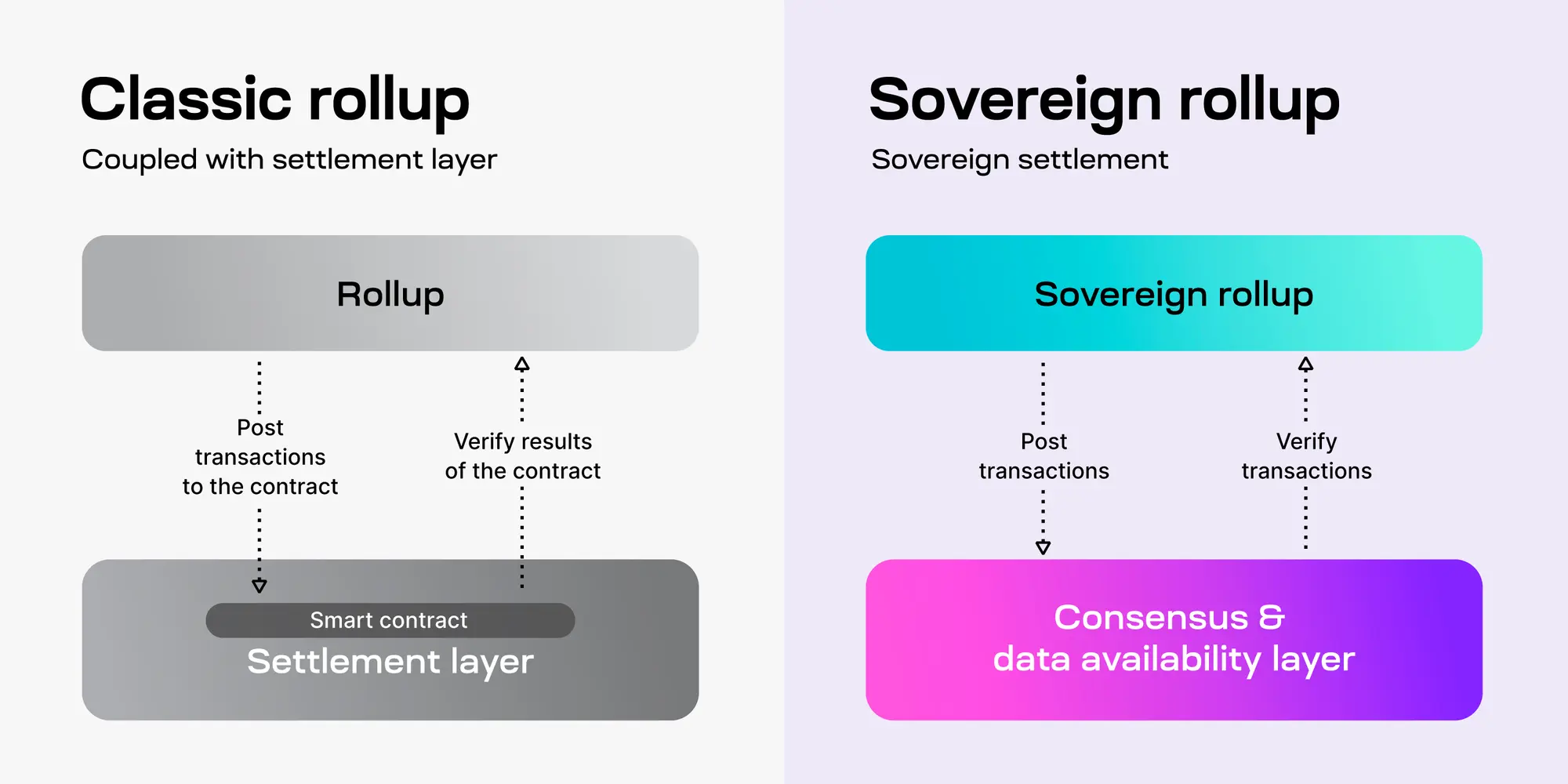
Sovereign rollups represent a structural shift in how Layer 2 networks interact with the broader blockchain ecosystem. Unlike traditional smart contract rollups that post execution data and validity proofs to a settlement layer like Ethereum, sovereign rollups decouple execution and data availability from settlement entirely [src-serp-5]. This architecture allows builders to prioritize custom execution environments and specific economic models without being constrained by the security assumptions of the base layer.
In this model, the rollup handles its own settlement logic, often relying on its own native token or a distinct consensus mechanism to finalize transactions. The primary blockchain serves mainly as a data availability (DA) layer, ensuring that transaction data is permanently recorded and accessible, but it does not validate the state transitions or enforce the rollup's rules. This separation reduces dependency on the L1's throughput and gas costs, offering a path toward greater operational independence.
The trade-off for this autonomy is a reduction in the immediate security guarantees provided by the L1. While traditional rollups inherit the cryptographic security of Ethereum, sovereign rollups must bootstrap their own security through economic incentives or validator sets. This makes them particularly attractive for cross-chain interoperability, where different chains can communicate more fluidly without forcing all activity through a single, potentially congested settlement hub.
Finality tradeoffs for DEX traders
When trading cross-chain DEXs, the speed of Rollup Settle directly impacts your slippage and capital efficiency. A faster finality window means your order fills quicker, but it often comes with a tradeoff: you might be relying on optimistic proofs that haven't been fully verified on Layer 1 yet. This creates a "trust gap" where your position is technically confirmed but not yet immutable.
For high-frequency traders, this distinction is critical. If you are executing large orders, waiting for full L1 finality reduces the risk of a chain reorg wiping out your fill, but it increases the chance that the market has moved against you in the meantime. Conversely, accepting faster, less-secure finality allows for tighter slippage tolerances but exposes you to bridge or proof-failure risks.
The settlement layer acts as the hub for this verification. As noted in industry analysis, settlement layers facilitate cross-rollup bridging and proof verification, ensuring that liquidity remains consistent across different chains. If you are trading volatile assets, understanding whether your DEX relies on a sovereign rollup (self-settled) or a shared security model like Ethereum L1 will dictate how quickly you can safely withdraw or rebalance.
Common rollup and settle: what to check next
Understanding the mechanics of rollup settle helps clarify how Layer 2s achieve speed without sacrificing security. Below are the most frequent questions about rollup definitions, settlement layers, and sovereign architectures.
No comments yet. Be the first to share your thoughts!